

Weekly Market Commentary - Week Ending Saturday, November 21, 2026
With all the ups and downs in the market over the past few weeks, I thought it would be helpful to take a little more time to discuss what’s been happening, put the recent volatility into perspective, and share how we at WealthTrust are navigating these markets while keeping our focus on the opportunities ahead.
Market Volatility: A Time for Perspective, Discipline, and Opportunity
The stock market experienced one of its most difficult weeks in recent years, raising concerns about technology valuations, artificial intelligence, and the direction of interest rates. While the decline deserves attention, we believe investors should distinguish between short-term market uncertainty and the long-term fundamentals that create investment opportunities.
A Difficult Week for Stocks — But Not a Reason to Abandon Long-Term Investing
There is no question that this has been a challenging week for investors. Stock prices declined sharply, market volatility increased, and concerns about the sustainability of the artificial intelligence investment boom contributed to selling across major stock market indexes. The technology sector, which has been a significant contributor to market performance in recent years, experienced particularly heavy selling.
By Friday's close, the S&P 500 and Dow Jones Industrial Average had entered correction territory, meaning they had declined at least 10% from their recent highs. The Nasdaq Composite also suffered a significant decline as investors reconsidered the valuations and earnings expectations of technology and AI-related companies.
The magnitude of the week's decline is worth acknowledging.
Major U.S. Index Performance
Week ended November 20, 2026
S&P 500 − 8.6%
Nasdaq Composite − 10.0%
Dow Jones Industrial Average − 8.0%
Russell 2000 Small Cap − 7.5%
Russel 1000 Growth Index - 11.44% (Year to Date -14.06%)
These are meaningful declines, and it would be inappropriate to dismiss them as ordinary day-to-day fluctuations. However, it is equally important to remember that a stock market correction does not automatically mean the economy is entering a recession or that the long-term outlook for corporate earnings has fundamentally changed.
Sometimes market corrections occur because the economy is weakening. Other times, they occur because stock prices have increased faster than the earnings and growth prospects of the underlying companies.
We believe the distinction is particularly important today. For investors who have experienced previous market cycles, the current volatility is a reminder that stock markets periodically need to adjust expectations. These adjustments can be uncomfortable, but they can also create opportunities for disciplined investors.
Our message at WealthTrust is straightforward: We recognize the seriousness of the recent decline, but we remain focused on corporate earnings, reasonable valuations, diversification, and long-term investment opportunities.
1. What Is Causing the Current Market Volatility?
Several developments have contributed to the recent selloff, but one of the most important is growing uncertainty about the enormous investments being made in artificial intelligence.
Artificial Intelligence: A Great Technology Does Not Always Mean a Great Investment at Any Price
Artificial intelligence has the potential to transform the way businesses operate. Companies are investing billions of dollars in data centers, computer chips, advanced software, and supporting infrastructure. The expectation is that these investments will eventually produce substantial improvements in productivity and profitability.
We believe AI has significant long-term economic potential. However, investors have begun asking an important question: How quickly will these enormous investments generate sufficient profits to justify their cost?
That question has become increasingly important as AI-related companies have experienced substantial stock-price appreciation. This week's selling was intensified by concerns about the financing and profitability of AI infrastructure, as well as disappointment surrounding the public-market debut of Anthropic. Nvidia and other technology-related companies experienced significant declines as investors reassessed expectations.
This does not necessarily mean the AI revolution is ending. Instead, investors may be entering a more selective phase in which actual earnings, cash flow, and return on investment become more important than enthusiasm about future possibilities. We view that as a potentially healthy development.
At WealthTrust, we have long believed that investors should evaluate a company's earnings prospects alongside the price they are paying for those earnings. A company can have excellent products, strong management, and attractive growth opportunities while still being an expensive investment. The challenge is determining whether its future earnings justify its current stock price.
Interest Rates Remain an Important Consideration
Interest rates are another source of uncertainty. When borrowing costs remain elevated, businesses face higher financing expenses, consumers may become more cautious, and investors often become less willing to pay exceptionally high valuations for future earnings. This can be particularly important for growth companies whose valuations depend heavily on profits expected many years into the future.
The market has also been concerned about the possibility that inflation could remain persistent, limiting the Federal Reserve's flexibility to reduce interest rates. These concerns have contributed to the repricing of stocks, particularly in technology-related industries. Nevertheless, interest rates are only one component of the investment outlook.
Corporate profitability, productivity improvements, business investment, and economic growth are also important.
We do not believe investors should make long-term portfolio decisions based exclusively on predictions about the Federal Reserve's next move.
2. Market Corrections Are Uncomfortable, but They Are Not Unusual
Investors naturally prefer markets that move steadily higher. Unfortunately, the stock market has never operated that way. Even during extended periods of economic expansion, investors experience corrections, changing market leadership, and temporary declines in confidence.
Consider the distinction between a market correction and a recession.
A market correction generally refers to a decline of at least 10% from a recent market high.
A recession involves a broad and sustained deterioration in economic activity.
The two can occur together, but they are not interchangeable.
Markets often decline in anticipation of economic weakness that may or may not develop. They can also recover before economic conditions visibly improve. This is one reason market timing is so difficult.
Investors who sell during periods of heightened concern must subsequently determine when to reinvest. Unfortunately, the strongest market rebounds can occur when headlines remain negative, and investor confidence is still low.
We believe the better approach is to evaluate whether the fundamental reasons for owning particular investments remain intact.
If earnings expectations are improving, financial conditions remain sound, and valuations become more attractive, a market decline may create an opportunity rather than a reason to abandon an investment.
Conversely, if a company's earnings outlook is deteriorating, the decline may reflect a legitimate change in its investment prospects.
The objective is not to ignore falling stock prices. It is to understand why they are falling.
3. The Economy Still Has Important Sources of Strength
While the financial markets have experienced significant volatility, it is important not to assume that stock market weakness automatically reflects a collapse in economic activity.
The American economy is supported by a broad range of businesses, industries, consumers, and investment activity. Technology is an important part of that economy, but it is not the entire economy. Businesses continue to invest in manufacturing, infrastructure, healthcare, energy, automation, and productivity improvements. Consumers continue to purchase essential goods and services, while companies regularly adjust their operations to changing economic conditions.
There have also been some encouraging economic developments amid the recent market weakness. For example, reports this week pointed to stronger-than-expected retail sales, even as concerns about technology valuations dominated market sentiment. We should not interpret one positive economic report as proof that the economy is immune to a slowdown. However, it does illustrate why investors should examine the broader economic picture rather than allowing stock market volatility to dictate their outlook.
Innovation Remains a Long-Term Growth Driver
One of the most encouraging aspects of the U.S. economy is its ability to innovate.
Artificial intelligence, advanced manufacturing, robotics, medical technology, and improvements in energy efficiency all have the potential to contribute to productivity growth. Productivity is particularly important because it allows companies to produce more goods and services with fewer resources. When businesses become more productive, they may be able to improve profitability while offering competitive prices. Over time, these improvements can support corporate earnings and economic growth.
We believe the long-term opportunities associated with innovation remain meaningful, even though the stock prices of companies participating in those developments may experience substantial volatility.
The key is distinguishing between promising technologies and attractively valued investments.
4. Corporate Earnings Matter More Than Daily Headlines
At WealthTrust, our investment philosophy is based on a simple principle:
Over time, corporate earnings are one of the most important drivers of stock prices. Short-term market movements can be influenced by emotions, interest rates, political developments, and investor expectations. However, companies that consistently grow earnings and generate attractive returns on invested capital generally have a stronger foundation for long-term investment success.
This is why our investment process places considerable emphasis on earnings expectations and revisions.
When analysts increase their estimates of a company's future earnings, it may indicate that the business outlook is improving. When analysts reduce their estimates, it may signal emerging challenges. During periods of market volatility, this distinction becomes especially valuable.
Imagine two companies whose stock prices have each declined 15%.
The first company continues to report improving earnings, increasing cash flow, and strong demand for its products.
The second company is experiencing declining sales, reduced profitability, and downward revisions to future earnings estimates.
Although both stocks have declined by the same percentage, their investment prospects may be very different.
The first company may offer an attractive opportunity at a lower valuation.
The second may warrant caution because its underlying business outlook is deteriorating.
Our objective is to distinguish between those situations.
We believe this disciplined focus on earnings provides a more reliable foundation for investment decisions than attempting to predict daily market movements.
5. Why Growth at a Reasonable Price Is Particularly Relevant Today
One of the central components of WealthTrust's investment methodology is Growth at a Reasonable Price, commonly known as GARP.
This philosophy combines the attractive characteristics of growth investing with the valuation discipline traditionally associated with value investing.
Growth investors seek companies capable of increasing revenues and earnings at above-average rates.
Value investors seek companies whose stock prices appear attractive relative to their earnings, cash flows, or underlying business value.
GARP seeks to combine both disciplines.
Rather than purchasing growth regardless of valuation, we seek companies with attractive earnings-growth prospects that can be purchased at reasonable prices.
We believe this approach is especially relevant when investors become concerned about excessive valuations.
Growth Is Important, but Price Matters
Consider two hypothetical companies.
Company A is expected to increase earnings by 25% annually but trades at 40 times expected earnings.
Company B is expected to increase earnings by 20% annually but trades at 18 times expected earnings.
Both companies may have attractive growth prospects. However, Company B may offer a more favorable relationship between expected growth and valuation. This does not automatically make Company B the superior investment. Business quality, financial strength, competitive position, and the reliability of earnings forecasts also matter.
Nevertheless, the example illustrates an important principle. Investors should not focus exclusively on how rapidly a company is growing. They should also consider how much they are paying for that growth.
At WealthTrust, our DBS investment methodology has emphasized this relationship for more than 24 years. We seek companies demonstrating improving earnings expectations while applying discipline to valuation and portfolio construction.
This approach can provide flexibility as market leadership shifts between growth-oriented and value-oriented companies. When growth investing is favored, companies with strong earnings expansion may benefit. When investors become more valuation-conscious, avoiding excessive prices may become particularly important.
No strategy performs well in every environment, but we believe combining growth and valuation discipline offers a sensible framework for long-term investing.
6. Diversification Becomes More Important When Market Leadership Changes
Over the past several years, a relatively small group of very large technology companies has accounted for a substantial portion of the performance of major stock market indexes. Many of these companies are exceptional businesses. However, their growing influence has also increased the concentration of certain market benchmarks. An index containing hundreds of companies may appear broadly diversified, yet a significant portion of its performance can depend on a relatively small number of stocks. When those companies experience sharp declines, the overall index can suffer even if many other businesses remain fundamentally sound.
This week's technology-led selloff demonstrated how quickly concentration risk can influence index performance.
As we have cautioned in previous market commentaries, the Russell 1000 Growth Index remains heavily concentrated in a relatively small number of large technology companies and is currently down by more than 14% this year. This concentration exposes investors to greater volatility when a handful of dominant stocks experience significant declines. Recent market volatility reinforces an important investment principle:
Diversification matters.
At WealthTrust, our disciplined investment methodology emphasizes diversification across companies and sectors, reducing excessive concentration risk while positioning portfolios to participate in growth opportunities across a broader range of the market.
We believe investors should evaluate not only the number of holdings in a portfolio, but also the concentration of risk across companies, industries, and investment themes.
Opportunities May Be Developing Outside Technology
As investors reconsider the valuations of highly popular growth stocks, opportunities may develop in other areas of the market. Industrial businesses, financial companies, healthcare providers, selected consumer businesses, and companies benefiting from infrastructure investment may offer attractive combinations of earnings growth and valuation. These industries are not immune to economic weakness, and investors must still evaluate each company's financial condition and earnings outlook.
However, we believe a disciplined investment process should search broadly for opportunities rather than relying on a handful of well-known companies.
The next phase of market leadership may look different from the previous one.
That is one reason we believe diversification and flexibility are important.
7. Artificial Intelligence Remains an Opportunity, but Selectivity Is Essential
Despite the recent weakness in AI-related stocks, we remain constructive about the long-term economic potential of artificial intelligence. AI is not limited to software developers and semiconductor manufacturers. Its applications extend across manufacturing, healthcare, financial services, transportation, energy, and numerous other industries.
Businesses may use artificial intelligence to reduce operating costs, improve customer service, accelerate product development, and increase productivity. These developments could create meaningful economic benefits over time. However, the companies that benefit most from AI adoption may not necessarily be the companies attracting the greatest investor attention today.
Some of the largest beneficiaries could be businesses that use artificial intelligence to improve profitability rather than those spending enormous amounts of capital to develop the underlying technology. This distinction may become increasingly important as investors focus more closely on return on investment.
We believe AI will remain an important investment theme, but it should be evaluated using the same fundamental principles that apply to every other investment.
Are earnings expectations improving?
Is the company generating attractive cash flow?
Does it have a sustainable competitive advantage?
Is its stock price reasonable relative to expected growth?
These questions become even more important when market enthusiasm gives way to uncertainty.
8. Volatility Can Create Attractive Investment Opportunities
When markets decline sharply, investors often focus on the losses rather than the opportunities. However, lower stock prices can improve prospective investment returns when the underlying fundamentals remain sound. A company that was too expensive several months ago may become more attractive following a significant decline.
Likewise, a business with improving earnings expectations may offer a more favorable entry point when broad market selling pushes its stock price lower. This does not mean every decline represents a buying opportunity. Some stocks fall because their earnings prospects have deteriorated, their valuations remain excessive, or their financial risks have increased. Others fall primarily because investors are reducing exposure to an entire sector or asset class.
The challenge is identifying the difference.
At WealthTrust, our investment methodology combines quantitative analysis, artificial intelligence momentum analysis, earnings-estimate revisions, and fundamental research.
Our objective is to identify companies with improving investment characteristics while monitoring potential deterioration in their earnings outlook.
We believe a disciplined process becomes especially valuable during periods of uncertainty. Rather than reacting emotionally to every market movement, we seek to evaluate the fundamental changes affecting individual companies.
Patience Is Also an Investment Decision
Not every decline requires immediate action.
Sometimes the appropriate decision is to maintain an existing investment. Other times, reducing exposure to a company with deteriorating earnings expectations may be prudent. And when valuations become attractive and earnings prospects remain favorable, adding exposure may be appropriate. The important point is that these decisions should be based on investment analysis rather than fear.
We believe patience and selectivity are particularly important when market volatility is elevated.
9. Risk Management Remains Essential
Although we remain constructive about long-term investment opportunities, we recognize that market corrections can deepen. There is no reliable way to determine precisely when a market decline will end. For that reason, risk management must remain an important component of portfolio construction.
At WealthTrust, we emphasize diversification, position sizing, valuation discipline, and monitoring of earnings trends.
Depending on the strategy's investment mandate and market conditions, cash, short-term Treasury securities, and tactical allocations may also play a role in managing portfolio risk. These tools cannot eliminate losses, but they can provide flexibility and liquidity during uncertain periods.
We believe risk management should be an ongoing process rather than a reaction to a sudden market decline.
A portfolio that is appropriately diversified and aligned with an investor's objectives may be better positioned to withstand volatility without requiring emotional decisions.
The objective is not to avoid every temporary decline. It is to manage risk while maintaining the ability to participate in attractive long-term opportunities.
10. What Should Investors Focus on in the Weeks Ahead?
Rather than trying to predict the next daily market movement, we believe investors should concentrate on five important developments.
First, corporate earnings. Are businesses continuing to grow profits, and are analysts increasing or reducing expectations for future earnings?
Second, valuations. Have recent declines brought stock prices closer to reasonable levels relative to expected earnings growth?
Third, interest rates and inflation. Are economic conditions allowing the Federal Reserve greater flexibility, or are persistent inflation pressures creating additional challenges?
Fourth, market leadership. Are investment opportunities broadening beyond the largest technology companies, or does market performance remain heavily concentrated?
Fifth, economic activity. Are consumer spending, employment, business investment, and productivity trends consistent with continued economic expansion?
These indicators can help investors determine whether market weakness is primarily a reassessment of valuations or reflects more serious deterioration in economic fundamentals.
We believe this distinction will be especially important as the market moves toward year-end.
11. WealthTrust's Investment Perspective
At WealthTrust Asset Management, our investment philosophy has been developed and refined through more than two decades of changing market environments.
We have experienced periods of strong economic growth, recessions, financial crises, rising interest rates, declining interest rates, and substantial changes in stock market leadership.
Each environment presents different challenges. However, the principles underlying our investment process remain consistent. We seek companies with attractive earnings-growth prospects, improving earnings expectations, and reasonable valuations. We combine quantitative analysis with fundamental research and momentum analysis to identify opportunities and manage risk.
Our GARP philosophy is designed to avoid the extremes of purchasing growth at any price or purchasing inexpensive stocks without sufficient regard for earnings quality.
We believe this balanced approach is particularly relevant in today's market environment.
The recent selloff has reminded investors that even outstanding companies can experience significant declines when expectations become excessive. At the same time, market weakness can create opportunities in companies whose earnings outlooks remain attractive.
Our objective is to distinguish between those situations while maintaining a disciplined approach to portfolio management.
We are not attempting to predict every market movement. Instead, we are focused on identifying businesses that offer attractive long-term investment characteristics while remaining mindful of valuation and risk.
12. Final Thoughts: Keep the Recent Decline in Perspective
This week's market decline has understandably created concern among investors.
The losses were significant, particularly among technology and AI-related companies, and additional volatility remains possible. However, we believe it is important to maintain perspective. Stock market corrections have occurred throughout history, including during periods when the economy ultimately continued to expand.
Businesses adapt. Innovation continues. Corporate earnings recover and grow when economic and competitive conditions permit. The recent decline may also encourage investors to become more selective, placing greater emphasis on profitability, financial strength, and reasonable valuations. We view that as a constructive development for disciplined investment management.
At WealthTrust, we remain focused on the principles that have guided our methodology: earnings growth, valuation discipline, diversification, and careful risk management.
We believe those principles are especially important when market sentiment becomes unsettled. Investors should not ignore the risks associated with the current environment, but neither should they assume that recent volatility has eliminated the opportunities available in the equity markets.
Some of tomorrow's most attractive investments may emerge from today's uncertainty.
The Bottom Line
Market volatility is uncomfortable, but it can also create opportunity.
The recent decline reminds us that investors must pay attention not only to growth expectations but also to the prices they pay for that growth. We remain cautiously optimistic about the long-term prospects for the U.S. economy and the ability of well-managed companies to generate attractive earnings growth. At the same time, we recognize that selectivity, diversification, and risk management are essential.
Our focus is not on predicting the next market headline.
It is on identifying companies with improving earnings prospects, attractive valuations, and the potential to create long-term value. The market may be experiencing a difficult November, but we believe disciplined investors should continue looking beyond today's volatility toward tomorrow's opportunities.
Please see the metrics below that show the valuations of our two strategies are very favorable compared to their benchmarks.
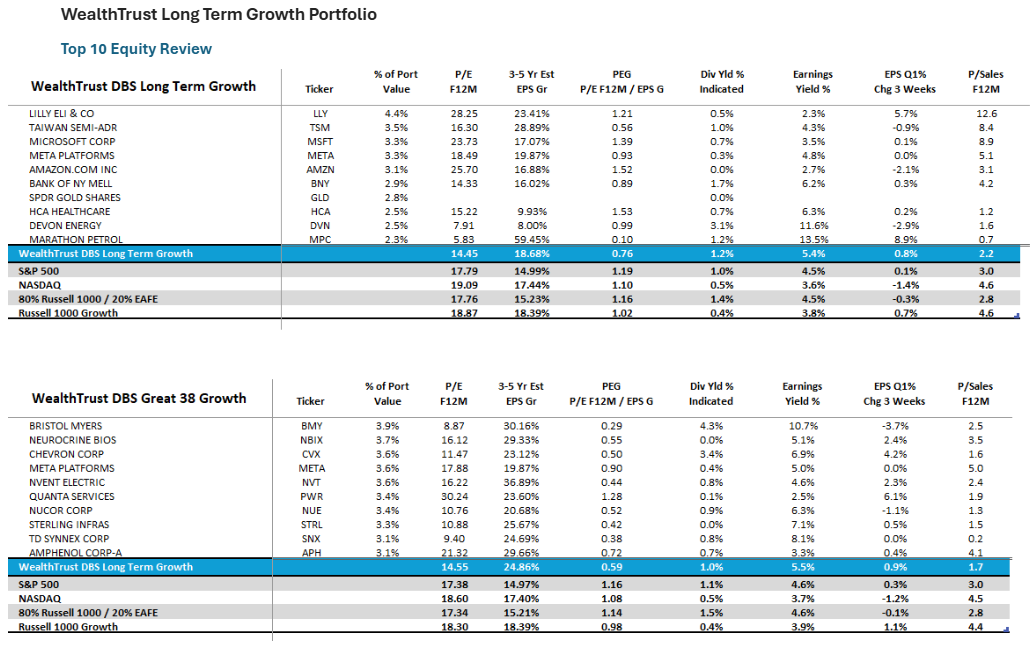
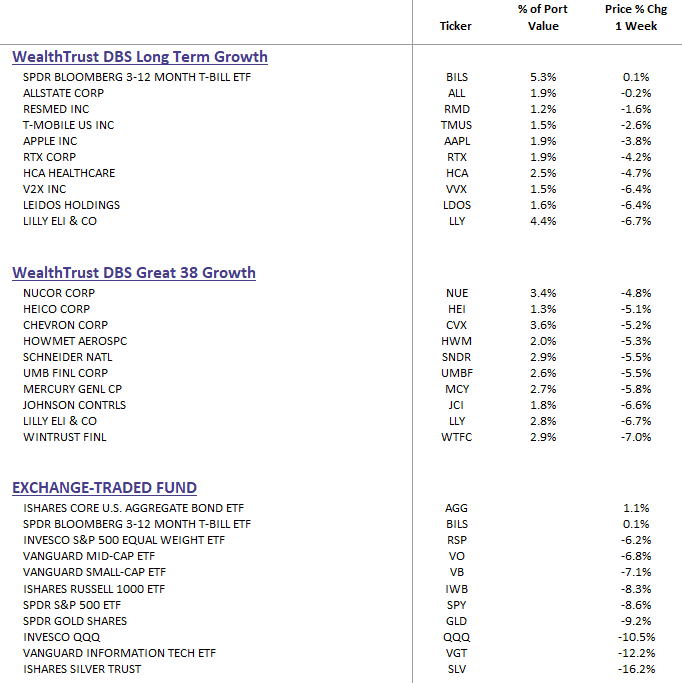
DBS Long-Term Growth & DBS Great 38 Large Cap Growth Top Ten and Benchmark Weekly Performance Summary
At WealthTrust, we are especially thankful for the relationships we have built, the trust our partners have placed in us, and the opportunity to develop new partnerships in the years ahead. Whether we are already working together or have the opportunity to do so in the future, we sincerely appreciate your interest and confidence in our firm.
From all of us at WealthTrust, we wish you and your family a wonderful and Happy Thanksgiving! John