

Weekly Market Commentary - Week Ending Saturday, October 31, 2026
As October comes to a close, investors find themselves navigating a market environment defined by both opportunity and uncertainty. Economic growth, corporate profitability, inflation, interest rates, and the extraordinary investment in artificial intelligence continue to influence investor sentiment. Yet beneath the daily headlines, an important principle remains unchanged: Over time, corporate earnings, valuations, and disciplined portfolio management are among the most important drivers of long-term investment success.
At WealthTrust Asset Management, we believe investors should approach the current environment with measured optimism rather than allowing short-term market fluctuations to dictate long-term investment decisions. Markets rarely move higher in a straight line, and periods of consolidation or increased volatility are not necessarily indications that a bull market has reached its conclusion.
In fact, periods of changing market leadership can create meaningful opportunities for active investment managers willing to look beyond the largest and most widely owned companies.
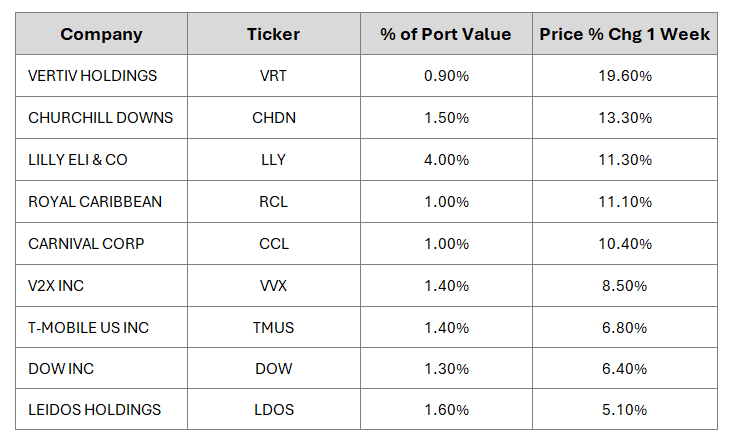
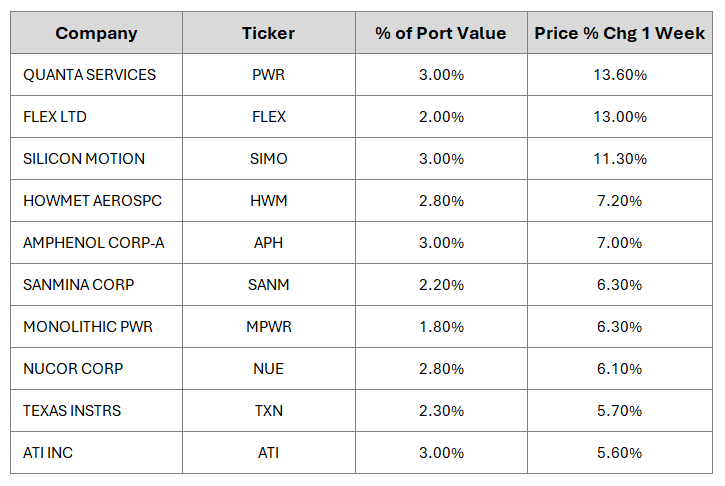
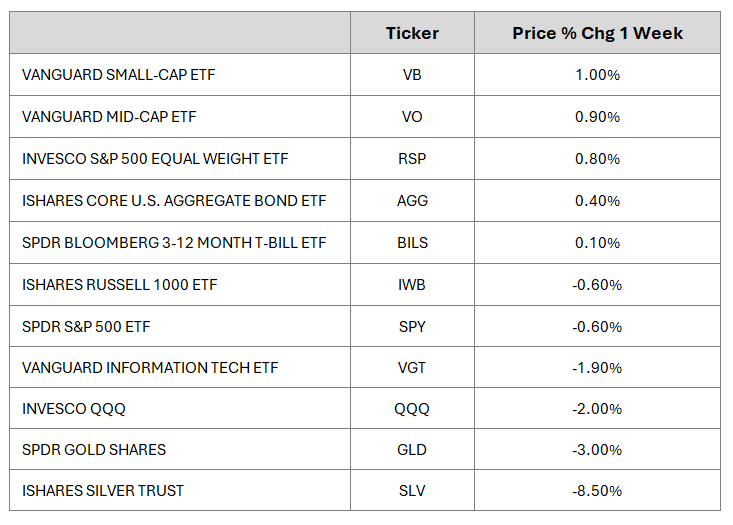
DBS Long-Term Growth & DBS Great 38 Large Cap Growth Top Ten and Benchmark Weekly Performance Summary
WealthTrust DBS Long Term Growth
WealthTrust DBS Great 38 Large Cap Growth
Exchange-Traded Fund ETF
Our investment philosophy remains straightforward: identify businesses demonstrating attractive earnings growth, improving fundamental characteristics, and favorable price momentum while maintaining a disciplined approach to valuation and portfolio diversification.
As we look toward the final two months of 2026 and into 2027, we believe these principles will become increasingly important.
1. The Economy: Resilience Remains an Important Foundation
One of the most encouraging characteristics of the American economy has been its ability to adapt to changing financial conditions. Consumers, businesses, and financial institutions have navigated an extended period of inflation concerns, shifting monetary policy, geopolitical uncertainty, and evolving trade relationships.
The economy's ability to absorb these challenges is important because sustainable equity-market advances generally require a foundation of economic activity and corporate profitability.
Consumer spending remains a critical variable. Household purchasing decisions influence revenues across a broad range of industries, including technology, financial services, industrials, transportation, housing, and consumer discretionary businesses.
However, the consumer is not a single, uniform group. Higher-income households may benefit from accumulated wealth and investment gains, while lower-income households may face greater pressure from housing costs, borrowing expenses, and everyday necessities.
This distinction makes it increasingly important to evaluate individual companies rather than assume that all businesses will benefit equally from economic expansion.
Corporate capital expenditures are another important component of the outlook. Investments in automation, infrastructure, advanced manufacturing, energy production, and artificial intelligence have the potential to improve productivity and support future earnings growth.
Our perspective: A resilient economy does not eliminate the possibility of slower growth, but it can provide a constructive backdrop for equities when accompanied by healthy corporate balance sheets and sustainable earnings expansion.
2. Federal Reserve Policy: The Direction of Interest Rates Matters
Interest-rate policy remains one of the most closely watched influences on financial markets.
Investors are understandably focused on the Federal Reserve's assessment of inflation, employment, economic growth, and financial conditions. However, the relationship between interest rates and stock prices is more complicated than simply assuming that lower rates automatically produce higher equity returns.
The reason for a change in monetary policy can be just as important as the change itself.
When interest rates decline because inflation is moderating, while economic growth remains healthy, businesses may benefit from lower financing costs, improved consumer purchasing power, and greater confidence in long-term capital investments.
Conversely, aggressive rate reductions in response to a rapidly deteriorating economy may not provide immediate support for corporate profits.
We believe investors should focus less on predicting the exact timing of every Federal Reserve decision and more on understanding how monetary conditions influence individual businesses.
Companies with strong balance sheets, consistent cash generation, manageable debt obligations, and pricing power may be better positioned to navigate changing interest-rate environments. At WealthTrust we emphasize investing in companies with higher free cash flow than the overall market.
Meanwhile, interest-rate-sensitive sectors such as housing, selected financial companies, and certain industrial businesses could benefit if financing conditions become more favorable.
The key is to distinguish between businesses that benefit from a sustainable improvement in financial conditions and those whose valuations depend on an optimistic interest-rate scenario.
3. Corporate Earnings: The Foundation of Sustainable Market Performance
While economic headlines and Federal Reserve announcements frequently dominate the financial news, corporate earnings remain central to our investment process.
A company's stock price ultimately reflects expectations about its ability to generate future profits and cash flow. Those expectations can change quickly, particularly when analysts revise earnings estimates in response to new information.
At WealthTrust, we place considerable emphasis on the direction of earnings expectations rather than relying exclusively on historical financial results.
A business reporting strong past earnings may still represent an unattractive investment if future earnings expectations are deteriorating. Conversely, a company experiencing improving analyst estimates, expanding margins, and favorable industry conditions may offer an attractive opportunity even when the broader market appears uncertain.
Our investment methodology incorporates artificial intelligence momentum analysis, quantitative screening, and fundamental research to identify companies exhibiting favorable investment characteristics.
We believe this combination provides a systematic framework for evaluating opportunities across market sectors.
An important distinction is that we do not simply purchase stocks because their prices are rising. We seek to determine whether positive price momentum is supported by improving business fundamentals and earnings expectations.
Similarly, when earnings revisions deteriorate or a company's fundamental outlook weakens, our investment discipline calls for reassessing that holding.
The central principle is simple: We want to own companies whose future earnings prospects are improving, while reducing exposure to businesses where those prospects are deteriorating.
This approach is particularly relevant during earnings season, when company-specific developments can create substantial differences in performance across industries and individual securities.
4. This Week's Market Performance: A Rotation Beneath the Surface
The final trading week of October illustrated why diversification and valuation discipline remain so important.
Technology shares experienced significant selling pressure as investors reassessed the profitability and capital requirements associated with artificial intelligence. Earnings announcements from several major technology companies raised questions about the timing of returns on substantial AI infrastructure investments.
Nevertheless, the weakness in major technology stocks did not extend uniformly across the market. Small-cap equities outperformed large-cap benchmarks for the week, highlighting the potential for changing market leadership.
Importantly, despite October's volatility, the S&P 500 remained approximately 10.7% higher for the year through October 30, but the Russell 1000 Growth Index is down (0.61%) for the year.
We believe this distinction deserves attention.
A decline in a relatively small number of heavily weighted technology companies can exert substantial downward pressure on market-capitalization-weighted indexes, even when other industries demonstrate improving fundamentals.
Investors who rely exclusively on headline index performance may overlook opportunities developing beneath the surface.
For active managers, this environment reinforces the importance of identifying individual businesses with improving earnings expectations rather than simply following the largest constituents of an index.
5. Artificial Intelligence: An Extraordinary Opportunity, but Valuation Still Matters
Artificial intelligence continues to represent one of the most significant technological developments of our time.
Its potential applications extend far beyond semiconductor manufacturers and large technology platforms. Businesses across healthcare, financial services, industrial manufacturing, logistics, defense, and consumer services are exploring ways to improve efficiency through AI-powered technologies.
We believe AI has the potential to create meaningful productivity improvements over the coming years.
However, investors must distinguish between the long-term economic potential of a technology and the price they are willing to pay for the companies developing or implementing it.
This week's earnings announcements demonstrated that distinction.
Microsoft reported strong cloud-business growth, while Alphabet and Amazon faced increased investor scrutiny concerning earnings performance and substantial capital expenditures. The market's reaction suggests investors are becoming more demanding about the relationship between AI investment and measurable financial returns.
That scrutiny is not necessarily negative for the broader investment outlook.
In fact, a market that increasingly differentiates between businesses with sustainable earnings growth and those relying primarily on investor enthusiasm may create a healthier foundation for future performance.
We believe the next phase of AI-related investment opportunities may increasingly favor companies that successfully translate technological innovation into revenue growth, expanding margins, and stronger free cash flow.
For WealthTrust, the objective is not to avoid innovation. Rather, it is to participate selectively while maintaining appropriate diversification and valuation discipline.
6. Inflation and Economic Growth: A More Complicated Picture
This week's economic releases presented investors with an important combination of strong growth and persistent inflation.
Third-quarter real GDP expanded at a reported annualized rate of 3.4%, while headline personal consumption expenditures inflation reached 3.6% year over year. The Federal Reserve maintained its benchmark interest-rate range at 3.75%–4.00% during its October meeting.
These developments suggest that economic activity remains substantial, but inflation continues to complicate the monetary-policy outlook.
Strong economic growth is generally constructive for corporate revenues. However, persistent inflation can place upward pressure on wages, operating expenses, and financing costs.
The result is an environment in which company-specific fundamentals become increasingly important.
Businesses with pricing power, strong operating margins, and efficient capital allocation may be better positioned to maintain profitability. Conversely, companies dependent on inexpensive financing or aggressive valuation assumptions could face additional challenges.
At WealthTrust, we believe a disciplined investment process should account for these differences rather than making portfolio decisions solely on predictions about interest rates.
Our preference remains to emphasize improving earnings fundamentals while maintaining the flexibility to adjust exposures as conditions evolve.
7. Diversification: One of the Most Important Lessons from Market History
Market concentration remains an important issue for investors.
Over recent years, a relatively small number of mega-cap technology companies have accounted for a substantial portion of major growth-index performance.
Although many of these businesses possess exceptional competitive advantages, their growing index weights can create unintended concentration risk for investors who believe they own broadly diversified portfolios. History provides a useful reminder.
During the 2000–2002 technology bear market, the capitalization-weighted S&P 500 experienced a cumulative decline of approximately 37.6%, compared with a decline of approximately 10.7% for its equal-weighted counterpart, using the historical series previously discussed.
The difference illustrates how concentrated market leadership can influence index performance during periods of changing investor expectations.
Today's market is not identical to the technology bubble of 2000. Many leading technology companies generate substantial profits, maintain strong balance sheets, and possess established global businesses.
Nevertheless, concentration risk should not be dismissed simply because the underlying companies are financially successful. A fundamentally attractive business can still represent an unattractive investment when its valuation becomes excessive.
8. Looking Ahead: Reasons for Constructive Optimism
Despite the recent increase in volatility, we see several potential sources of investment opportunity as 2026 approaches its conclusion.
First, economic growth continues to provide support for corporate activity, even as inflation presents challenges. Businesses that can expand earnings and maintain profitability may continue to attract investor capital.
Second, changing market leadership could create opportunities outside the most heavily owned technology companies. Financial services, industrials, healthcare, selected consumer businesses, and infrastructure-related industries may offer attractive prospects where valuations and earnings trends align.
Third, continued innovation in artificial intelligence, automation, and advanced manufacturing could contribute to long-term productivity growth across multiple sectors of the economy.
Finally, market volatility itself can create opportunities.
When investor sentiment shifts rapidly, high-quality companies may experience price declines that are disproportionate to changes in their underlying earnings prospects.
For disciplined active managers, these dislocations can create attractive entry points. We currently maintain 12.5% in short term treasuries and cash in the DBS Long Term Growth Strategy to participate in potential lower priced opportunities.
However, we remain mindful of risks associated with persistent inflation, elevated interest rates, geopolitical developments, and the possibility that corporate earnings expectations could weaken.
The objective is not to predict every market fluctuation. It is to maintain a repeatable investment process capable of identifying opportunities while responding systematically to changing fundamentals.
What we'll be watching next week
The first week of November will bring additional information about manufacturing activity, services-sector conditions, employment trends, and corporate earnings.
In particular, investors will closely monitor upcoming employment data for indications of whether labor-market conditions remain consistent with continued economic expansion.
Additional technology earnings announcements will also provide insight into AI investment spending, demand trends, and corporate profitability.
These developments may influence short-term market direction, but we believe the more important consideration is whether earnings expectations across the broader market continue to support attractive long-term investment opportunities.
9. WealthTrust's Investment Perspective: Discipline Over Emotion
At WealthTrust Asset Management, our investment philosophy is built around the belief that successful long-term portfolio management requires more than simply participating in market advances.
It requires identifying attractive opportunities, understanding valuation and concentration risks, and maintaining the discipline to adjust investments when fundamental conditions change.
Our investment process combines AI-driven momentum analysis, quantitative screening, and fundamental research to identify companies with favorable earnings characteristics.
Rather than relying on predictions about the economy, interest rates, or political developments, we emphasize measurable changes in company fundamentals and market behavior.
We also believe diversification is especially important when major indexes become increasingly concentrated in a relatively small number of companies.
Our objective is to participate in attractive growth opportunities while avoiding unnecessary exposure to risks that may not be adequately compensated.
This philosophy does not eliminate market volatility or guarantee superior performance. It does, however, provide a consistent framework for making investment decisions across changing market environments.
Final Thoughts: Focus on Opportunity, Not Uncertainty
As we enter the final two months of 2026, investors have understandable reasons to remain attentive to inflation, Federal Reserve policy, geopolitical uncertainty, and elevated valuations in certain areas of the equity market. Yet there are also important reasons for optimism.
The American economy continues to demonstrate meaningful productive capacity. Corporate innovation remains strong, technological advancements are creating new business opportunities, and changing market leadership may broaden the investment opportunity set.
The recent pullback in several highly valued technology companies serves as a reminder that even outstanding businesses can experience significant price volatility when expectations become excessive.
We believe the greatest opportunities ahead may come not from chasing yesterday's market leaders, but from identifying tomorrow's earnings leaders at reasonable valuations(GARP).
At WealthTrust Asset Management, we remain committed to our disciplined investment process, emphasizing earnings momentum, quantitative analysis, fundamental research, and prudent diversification.
We believe investors are best served by maintaining a long-term perspective, recognizing that temporary volatility is a normal part of investing, and remaining focused on the fundamentals that ultimately drive shareholder value.
Our outlook remains constructively optimistic, with an emphasis on selectivity, valuation discipline, and opportunities across a broader range of market sectors.
The market will undoubtedly present additional challenges, but it will also continue to create opportunities for investors prepared to recognize them.