

Weekly Market Commentary - Week Ending Saturday, October 3, 2026
Executive Summary - Earnings over stories in stocks. Real income back in bonds
September—and the final week of the month—marked a clear “reset” moment for U.S. markets:
- Equities: Major U.S. indexes finished September and Q3 lower as long‑term Treasury yields pushed to multi‑year highs. Leadership stayed narrow, and the market became more punishing of earnings misses and soft guidance.
- Fixed income: The 10‑year Treasury yield moved sharply higher as investors accepted a “higher for longer” rate path from the Federal Reserve. Bond prices fell, but yields for savers and income investors are now the most attractive in over a decade.
- Economy: Growth is slowing but still positive. The job market is easing off the boil, inflation is well below its peak but not yet “solved,” and higher energy prices added fresh noise late in the month.
For U.S. investors, September underscored two realities: the Fed is no longer a quick safety net for markets, and both stocks and bonds are repricing to a world where money is not free.
September & Final Week Recap: What Drove Markets
1. Equities: Higher Yields, Narrow Leadership, Sharp Reactions
Headline move:
U.S. stocks declined in September, giving back part of their year‑to‑date gains. The last week of the month featured intraday rebounds that faded as yields climbed again.
Key dynamics:
- Valuation pressure from rates
- The rise in the 10‑year Treasury yield directly pressured equity valuations—especially high‑growth, high‑multiple names whose earnings lie further in the future.
- As the “risk‑free” rate rose, investors became less willing to pay up for long‑duration stories without clear near‑term earnings power.
- Narrow leadership remains
- A small group of mega‑cap technology and communication services stocks still accounts for a disproportionate share of the S&P 500’s gains for 2026.
- Beneath that surface, many mid‑cap and small‑cap names—and more cyclical businesses—have lagged significantly, especially as borrowing costs bite.
- Sector performance
- Energy: One of the few bright spots. Rising oil prices on the back of supply discipline and steady demand supported energy sector earnings and share prices.
- Defensives (staples, healthcare, utilities): Not immune from volatility, but generally held up better than the broad market in September’s sell‑offs.
- Cyclicals & rate‑sensitives: Financials, REITs, and some industrials struggled with the combination of higher long rates and worries about future growth.
- Earnings sensitivity
- Companies that:
- Missed estimates, again our historically proven sell discipline resulted in fewer earnings misses from the 2nd. Quarter results.
- Guided cautiously, or
- Showed margin pressure
were hit disproportionately hard.
- The market showed less patience for “we’ll make it up next quarter” narratives and more focus on actual numbers.
- Companies that:
Final week flavor:
The last week of September saw brief rallies when data suggested a softer landing was still plausible, but each move ran into the same headwind: another leg up in Treasury yields. That pattern—equity strength fading into higher rates—defined much of the week.
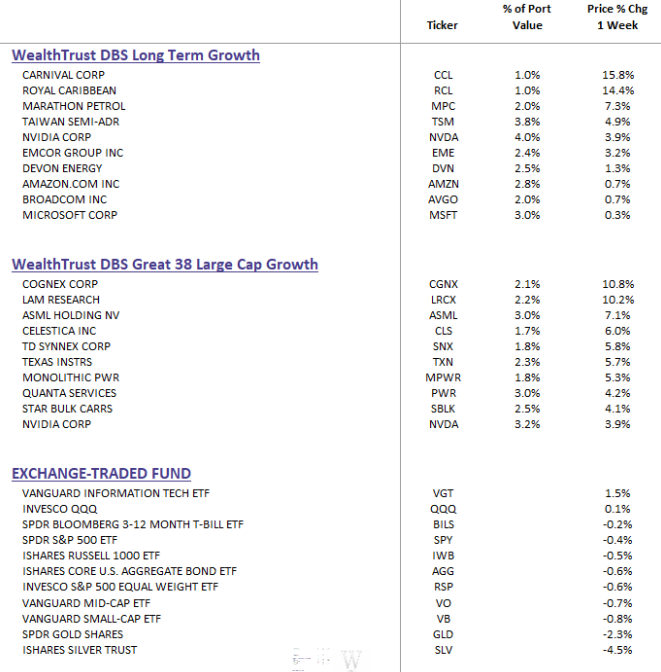
DBS Long-Term Growth Top Ten & DBS Great 38 Large Cap Growth and Benchmark Weekly Performance Summary
2. Fixed Income & Rates: The 10‑Year Reprices the Cycle
The main story: Rates moved, and they moved a lot.
- 10‑year U.S. Treasury yield
- Climbed meaningfully through September and remained elevated into month‑end.
- Drivers:
- Markets stepping back from the idea of aggressive, early Fed cuts.
- A reassessment that the “neutral” rate (where policy is neither too tight nor too easy) may be higher than in the decade after the financial crisis.
- Concerns over fiscal deficits and Treasury supply, which can pressure long‑term yields higher.
- Yield curve
- Still inverted (short‑term yields above long‑term), but:
- The inversion narrowed because long‑term yields rose faster than short‑term ones.
- This “bear steepening” is often associated with markets pricing in higher real rates and more persistent inflation risk.
- Still inverted (short‑term yields above long‑term), but:
- Credit markets
- Investment‑grade credit:
- Spreads widened modestly, but trading remained orderly.
- All‑in yields (Treasury + spread) reached levels that are finally compelling for income investors.
- High yield:
- Spreads drifted wider, more so in riskier pockets.
- No broad signs of panic, but markets are clearly differentiating between strong and weak balance sheets.
- Investment‑grade credit:
For investors:
September was painful for bond prices but constructive for future returns. New money can now lock in yields that were unimaginable just a couple of years ago—even in high‑quality segments.
3. The Fed & Policy: “Higher for Longer” Becomes Real
Fed messaging in September:
- Policy is already restrictive—but that doesn’t mean cuts are near.
- The Fed is more worried about cutting too soon and letting inflation flare back up than about keeping rates high for a bit too long.
- Future decisions are data‑dependent, but the bar to ease is higher than it was earlier in 2024.
Market reaction:
- Fed funds futures markets:
- Dialed back the number and timing of expected cuts.
- Pushed the implied path of rates up and out in time—fewer cuts, coming later.
- Longer‑term yields:
- Responded by rising significantly, as investors demanded more compensation to hold Treasuries in a world where rates may stay elevated for years, not months.
Bottom line:
The “Fed put”—the idea that the Fed will quickly ease whenever markets wobble—is much weaker in this cycle. Policy will respond more to the path of inflation and employment than to short‑term equity market declines.
4. U.S. Economy & Inflation: Cooling, Not Cracking
Growth:
- Most data released in September pointed to moderate but positive growth:
- Consumer spending continued, though at a slower pace.
- Manufacturing remained soft; services remained the relative bright spot.
- There are visible pockets of strain (lower‑income households, interest‑sensitive sectors like housing), but no broad signs of an imminent, deep recession.
Labor market:
- Job openings have declined from extreme highs but are still above pre‑COVID levels.
- Unemployment remained low by historical standards.
- Wage growth has cooled but remains a bit above the level the Fed would consider fully consistent with 2% inflation.
Inflation:
- Goods inflation continued to ease as supply chains and inventories normalized.
- Services inflation—particularly shelter and labor‑intensive areas—remained sticky.
- Energy prices moved higher late in the summer and into early fall:
- Oil supply discipline by key producers, plus resilient demand, pushed crude higher.
- That filtered into gasoline prices, lifting headline inflation and complicating the Fed’s job.
Net effect:
The economy is cooling—not collapsing. Inflation is falling—not finished. That mix is exactly why the Fed can keep rates elevated and why markets have had to reprice the entire rate curve higher.
5. Other Cross‑Currents: Commodities, Dollar, and Global Tone
- Commodities
- Oil: Stronger on supply cuts and decent demand, supporting energy stocks but adding to inflation concerns.
- Industrial metals: Choppy, reflecting uncertain global growth and China’s uneven recovery.
- U.S. dollar
- The dollar stayed firm to strong as:
- U.S. yields outpaced many developed peers.
- The U.S. economy remained relatively more resilient.
- A strong dollar:
- Puts pressure on emerging markets and U.S. multinationals’ overseas earnings.
- Helps tame imported inflation for U.S. consumers.
- The dollar stayed firm to strong as:
- Global markets
- Europe & UK: Struggled with weaker growth signals and their own inflation challenges.
- Japan: Equities held up better in local terms, but yen weakness muted dollar‑based returns.
- Emerging markets: Mixed, with commodity‑linked and fiscally stronger countries doing better than those with twin deficits or political strain.
For U.S.‑based investors, the combination of a strong dollar and higher U.S. yields kept many looking domestically for both equity and fixed income exposure.
What This Backdrop Means for Portfolios Right Now
Equities: A Market That’s More Selective
In a September‑style tape, the market is clearly:
- Less willing to pay high multiples for unproven or distant earnings, and
- More focused on current and near‑term earnings power and balance‑sheet resilience.
Practically, that means:
- Quality and earnings resilience are being rewarded relative to pure “story” stocks.
- Companies with:
- Strong cash flows,
- Reasonable balance sheets, and
- The ability to pass on some cost pressure
are better positioned than those reliant on cheap financing or aggressive accounting.
- Markets are quicker to punish:
- Earnings misses,
- Margin disappointments, or
- Overly optimistic guidance.
Periodic pullbacks like the one in September can create better entry points into higher‑quality names whose long‑term stories are intact but whose prices have reset.
Fixed Income: Bonds Are Relevant Again
For the first time in a long time:
- Cash and short‑term Treasuries provide respectable yields.
- Intermediate‑term, high‑quality bonds (Treasuries, agencies, investment‑grade corporates) offer:
- Meaningful income,
- Reasonable interest‑rate risk, and
- A realistic chance to act as a portfolio shock absorber if growth slows more than expected.
This changes the calculus for many investors:
- Balanced portfolios don’t have to depend as heavily on equity returns to meet long‑term goals.
- Retirees and conservative investors can:
- Lock in higher levels of income,
- Reduce their reliance on selling stocks into weakness to generate cash.
Key Risks and Opportunities as We Leave September
Main Risks
- Policy misstep
- The Fed could over‑tighten and push the economy into a deeper downturn.
- Or it could ease too soon and let inflation rekindle, forcing another round of hikes later.
- Earnings slowdown
- Higher wages, higher interest costs, and still‑elevated input prices could squeeze profits, especially if revenue growth slows.
- Markets that are already more sensitive to misses could react sharply.
- Credit stress
- As more corporate and consumer debt rolls over at higher rates, weaker borrowers could struggle—especially in lower‑rated corporate bonds and leveraged areas of the economy.
- Geopolitics and U.S. politics
- Ongoing conflicts, trade tensions, and a crowded U.S. political calendar can create sudden volatility spikes and sector rotations unrelated to longer‑term fundamentals.
Main Opportunities
- High‑quality bond income
- Treasuries and high‑grade corporates now offer yields that can be the backbone of a more stable, income‑oriented allocation.
- Better equity entry points
- Pullbacks in quality names driven more by rate moves than by fundamental deterioration can be attractive opportunities for long‑term investors.
- Restored diversification
- With positive real yields, high‑quality bonds can once again serve as a more reliable counterweight to equities in balanced portfolios.
- Return of fundamentals
- As cheap money fades, markets are becoming more discriminating—tilting in favor of companies with real, sustainable earnings and away from purely narrative‑driven stories.
How WealthTrust Is Framing This Environment
While the focus here is on markets, not process, it’s worth summarizing how WealthTrust is interpreting September’s message:
- On stocks
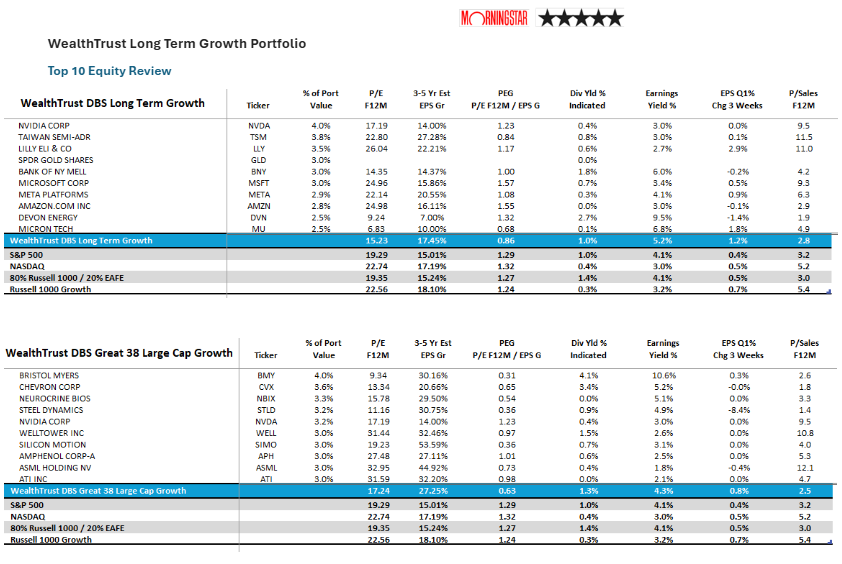
- September reinforced that this is a market that rewards real earnings, clean accounting, and reasonable valuations, and punishes misses and weak guidance.
- We are paying close attention to:
- Earnings revisions,
- Margin trends,
- Balance‑sheet strength, and
- Management’s tone on calls,
recognizing that those signals matter even more when rates are rising.
- On bonds
- The repricing in rates is painful for existing holders but positive for forward‑looking investors.
- We see real value in:
- Short‑ and intermediate‑term Treasuries
- High‑quality corporates
as tools for income and risk control.
- At the portfolio level
- We’re in a regime where:
- The Fed is less of a backstop,
- Earnings dispersion is rising,
- And bonds finally pay investors again.
- That combination puts a premium on:
- Diversification,
- Quality,
- And staying anchored to long‑term plans rather than reacting to every data print.
- We’re in a regime where:
As we move into the final quarter of the year, September’s market action is best seen not as a one‑off shock, but as part of a broader adjustment to higher real rates and a more demanding market. For U.S. investors, that means:
- Expect a more selective equity tape,
- Take advantage of improved bond yields where they fit your goals, and
Keep decisions grounded in fundamentals and time horizon, not headlines.