

Weekly Market Commentary: September 12, 2026
Markets spent this week doing what they often do when two powerful forces collide: they priced the inflation shock first, then they priced the earnings reality second. Oil and Treasury yields did most of the damage from Tuesday through Thursday. A late-week pullback in crude and a Friday bounce after the August CPI report allowed the major averages to recapture a meaningful share of the week’s losses. The rebound was welcome. It was not a clean bill of health.
The S&P 500 closed Friday at 7,656.98, up 0.86% on the day and down 0.8% for the week. The Dow Jones Industrial Average finished at 52,573.29, up 0.98% Friday and down about 1.6% for the week. The Nasdaq Composite ended at 26,333.04, up 0.96% Friday and down roughly 0.7% on the week. Small-caps absorbed the heaviest blow. The Russell 2000 closed at 2,903.94, up 0.4% Friday but down 2.4% for the week.
Year-to-date, the scoreboard still looks constructive if you are willing to look through a noisy September. The S&P 500 is up about 11.9%. The Nasdaq Composite is up about 13.3%. The Dow is up about 9.4%. The Russell 2000 remains the quiet leader of 2026, up roughly 17% year-to-date even after this week’s slide. That last number matters. Leadership has been broader than the mega-cap narrative of the last two years, and that rotation is now being tested by higher yields.
The week’s message was simple. Energy is back in the inflation equation. The Federal Reserve’s September 15–16 meeting is no longer a coin flip. And corporate America, at least in the parts of the economy tied to artificial intelligence infrastructure, is still delivering.
DBS Long-Term Growth & DBS Great 38 Large Cap Growth Top Ten and Benchmark Weekly Performance Summary
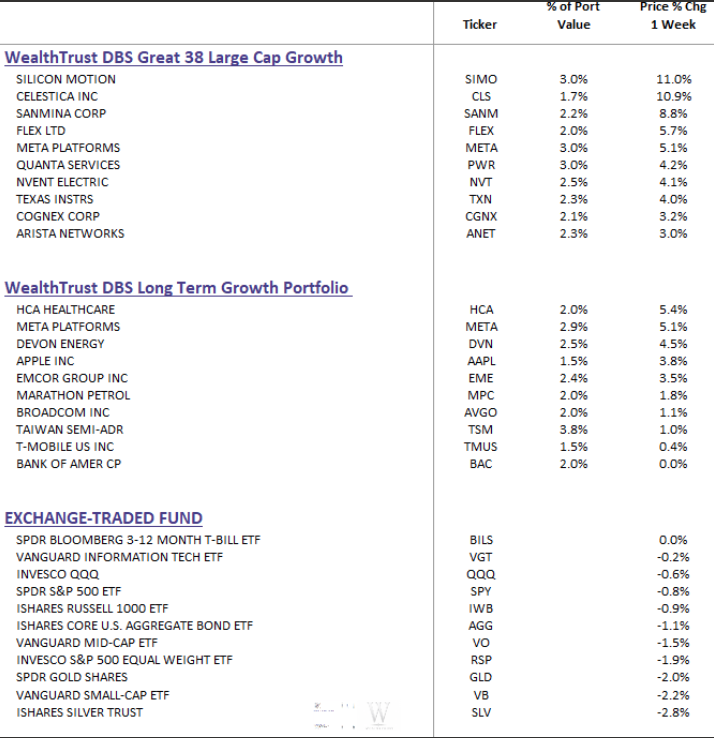
The week’s three drivers: oil, yields, and the last print before the Fed
Markets were closed Monday for Labor Day. They reopened Tuesday into a familiar combination: higher crude, higher yields, and a market that had already absorbed a much stronger-than-expected August employment report the prior Friday. Nonfarm payrolls rose 162,000 in August against expectations closer to 50,000–60,000. The unemployment rate held at 4.1%. Wage growth cooled to 3.1% year-over-year, the slowest reading since May 2021. A strong labor market with slowing wage growth is not a crisis. It is, however, a market that gives the Fed less cover to look through an energy shock.
Oil did the heavy lifting. Escalating disruption along Middle East shipping routes pushed Brent crude through $100 and, at the peak of the week, toward the mid-$100s. WTI traded through $100 as well. Friday brought a diplomatic-headline fade: Brent settled at $104.61, down $3.02 or 2.8% on the day, and WTI settled at $100.05, down $2.43 or 2.4%. Both benchmarks still posted weekly gains of more than 8%. Brent’s weekly advance of 8.65% was its largest one-week net gain since late July. That is not a rounding error. It is a supply shock working its way into the price level.
Bond markets treated it as such. The 10-year Treasury yield closed the week near 4.97%, up roughly 18–20 basis points from last Friday and at the high end of its 2026 range. When the risk-free rate moves that far in four sessions, every duration-sensitive asset has to reprice. Small-caps, homebuilders, and rate-sensitive consumer names felt it first. That is why the Russell 2000 lagged so clearly. Higher oil raises input costs. Higher yields raise the discount rate. Smaller companies typically carry more floating-rate debt and less pricing power. The market remembered that this week.
Volatility rose, then receded. The VIX spent the middle of the week closer to 17–18 before settling back near 15–16 on Friday. That is elevated relative to the midsummer calm, not a panic reading. Breadth was poor through Thursday and improved on the bounce. Energy was the only sector that finished the week with a clear lead, up about 2%. Communication services also held up. Healthcare was the week’s weakest group, down about 3.6%, pressured by drug-trial headlines and the usual multiple compression that arrives when yields jump. Financials, industrials, utilities, and materials all finished lower. Technology was roughly flat to modestly lower on the week, which, given the rate move, was a relative show of strength.
Inflation: the annual rate improved; the monthly rate did not cooperate
Friday’s CPI report was the last major inflation print the Federal Open Market Committee will see before Wednesday’s decision. It was not a disaster. It was not a hall pass.
Headline CPI rose 0.4% in August after 0.1% in July, leaving the 12-month rate unchanged at 3.4%. Core CPI, which excludes food and energy, rose 0.3% on the month versus a 0.2% consensus. The 12-month core rate eased to 2.4% from 2.5% — the lowest annual core reading since March 2021. That split is the entire debate in one paragraph. The level of underlying inflation continues to grind lower. The speed of that grind is not fast enough for a committee that has spent more than five years above its 2% target and is now staring at a fresh energy spike.
The composition matters. Energy rose 2.1% in August and is up 16.3% over the past year. Gasoline rose 3.9% on the month and 27.4% year-over-year. Fuel oil is up 52% over 12 months. Food was well behaved: +0.1% on the month, +2.7% over the year, with grocery prices essentially unchanged in August. Shelter rose 0.3% monthly; the 12-month shelter rate cooled to 3.0%. Medical care and motor-vehicle insurance declined. Airline fares, communication, lodging, and used vehicles added to core. In other words, this was not a broad-based explosion in goods prices. It was energy reasserting itself on top of a services inflation problem that has been improving, not disappearing.
Producer prices, released Thursday, pointed the same direction. Headline PPI rose 5.4% year-over-year, hotter than expected. Pipeline pressure from energy and transportation is not theoretical. Contacts in the Fed’s Beige Book have been reporting elevated input costs in manufacturing and construction for months. When crude is up nearly 9% in a week and diesel has traded through $6 a gallon nationally, those anecdotes become the next CPI print.
University of Michigan’s preliminary September sentiment slipped to 47.8, and one-year inflation expectations jumped to 4.6%. Soft data can overshoot. Markets still watch it because household inflation psychology is how an energy shock becomes a wage shock. Wage growth is not reaccelerating yet. That is the most important offset in the entire report.
Our working conclusion: the disinflation trend in core goods and, more recently, in shelter is intact. The energy shock is not. Until oil stops rising, headline CPI will keep handing the hawks fresh material.
The Fed meeting that will set the tone for the fourth quarter
The federal funds target range remains 3.50% to 3.75%. After Friday’s CPI, federal funds futures placed the odds of a 25-basis-point hike on September 16 near 85–90%, up from roughly 70% on Thursday and far above the mid-August coin-flip. A hike would take the range to 3.75%–4.00% — the first increase in three years. The European Central Bank already moved this week, lifting its policy rate 25 basis points. The global easing narrative of early 2026 is no longer the base case.
Chair Kevin Warsh has been explicit that the 2% objective is not a suggestion. His Jackson Hole standard was that the Committee must be confident underlying inflation is moving toward target “clearly and at sufficient speed.” August core at +0.3% month-over-month is not that speed. A 9–3 hold in July already advertised the internal split. Credibility, once questioned, is expensive to rebuild. Markets have begun pricing not just one hike but a short sequence into early 2027. That is the risk the bond market is forcing equity investors to underwrite.
We will not pretend to know the vote count. We will watch three things Wednesday afternoon: the decision itself, the new Summary of Economic Projections, and the press conference. The dots will tell us whether September is a one-and-done insurance hike or the start of a campaign. The language around energy — whether the Committee treats oil as a one-time supply shock or as evidence that inflation is broadening — will matter as much as the 25 basis points.
A hike is not automatically bearish for stocks if earnings continue to rise faster than the discount rate. It is bearish for the parts of the market that were priced for easier money: unprofitable growth, highly levered small-caps, and anything whose entire thesis was “the Fed will cut.” That distinction is the job of active management.
Earnings still matter more than the headline
In a week dominated by oil and the Fed, it was easy to miss the fundamental signal. Oracle reported fiscal first-quarter results Thursday that were, by any reasonable standard, a confirmation of the AI infrastructure cycle rather than a late-cycle fade.
Total revenue rose 30% to $19.3 billion. Cloud infrastructure revenue jumped 121% to $7.4 billion. Remaining performance obligations — contracted future revenue — climbed to $664 billion after more than $30 billion of new AI cloud contracts in the quarter. Non-GAAP earnings of $1.92 per share beat the $1.74 consensus. The company raised its fiscal 2027 adjusted EPS outlook to $8.10 and guided to at least $90 billion of full-year revenue. Gross margins compressed, as they should when a company is standing up capacity at this pace. Free-cash-flow burn was smaller than feared. That combination — demand still outrunning supply, backlog still growing, cash burn better than modeled — is what a durable capex cycle looks like, not what a narrative peak looks like.
The stock’s mixed after-report reaction is the market doing its job: paying for growth, docking for margin and duration risk when the 10-year is almost 5%. Dell, by contrast, pushed to a record high as hardware demand stayed firm. That is consistent with what we have been screening for all year. The companies converting AI demand into reported revenue and upward estimate revisions continue to be treated differently from the companies that only talk about AI.
Q3 earnings season for the S&P 500 does not begin in earnest until mid-October. Consensus is still looking for another quarter of 25%+ year-over-year earnings growth, with energy and technology expected to lead. Full-year 2026 S&P 500 earnings growth estimates have been revised higher through the year, not lower — from the mid-teens at the start of 2026 toward the low 30s more recently. That is the single most important fact underneath this market. Multiples can compress when yields jump. Earnings revisions are what determine whether the compression is a buying opportunity or the start of a genuine bear market. We still follow the revisions, not the narrative.
Rotation, size, and what the tape is telling us
Two rotation stories defined 2026 into early September. First, small-caps led large-caps for much of the year. Second, energy and cyclicals periodically took the baton from mega-cap growth when oil firmed. This week stressed both.
The Russell 2000’s year-to-date advantage is real. Many of those companies earn most of their revenue inside the United States, which insulated them from some of the earlier geopolitical shocks. They are not insulated from a 5% 10-year or from $100 crude. A 2.4% weekly decline does not end the small-cap cycle. It does remind investors that the cost of capital is the governor on that trade. If the Fed hikes and the 10-year stays near 5%, the quality screen inside small-caps — positive earnings, declining leverage, upward estimate revisions — will matter more than the index itself.
Inside large-caps, the week was a textbook illustration of why we do not run a single-factor portfolio. Energy worked. Healthcare did not. Technology held its own because the earnings tape in cloud and infrastructure is still strong. Equal-weight versus cap-weight remains a live debate: when the mega-caps are the earnings engines, cap-weight remains in the discussion. When breadth is improving and rates are stable, equal-weight and small-caps earn a larger sleeve. Rates were not stable this week. We respect that.
The process does not change because oil is loud. We still start with the numbers: estimate revisions, earnings quality, and a sell rule when the revision trend breaks. AI remains a factor inside the screen, not a substitute for it. A company spending tens of billions on data centers with no evidence of incremental revenue is a different holding from a company whose cloud backlog just added $30 billion in 90 days. The market is beginning to make that distinction. We have been making it for some time.
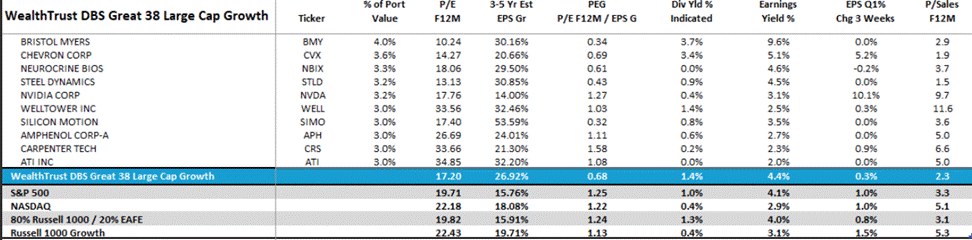
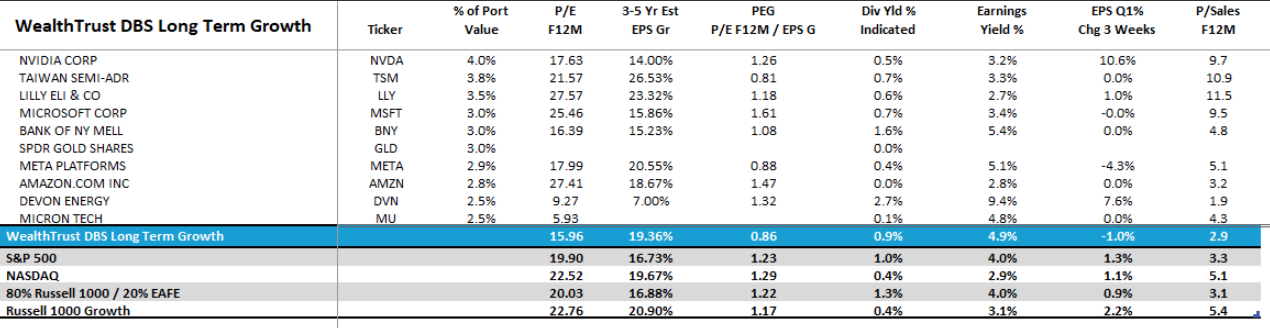
Top 10 Holdings and Metric Comparisons
What we are watching next week
The calendar is not gentle.
- Wednesday, September 16: FOMC decision, new economic projections, and Chair Warsh’s press conference. This is the week’s event. Retail sales, industrial production, and import prices will fill in the demand picture around it.
- Oil and shipping headlines remain a live input, not a background risk. A further break below $100 WTI would take pressure off both CPI expectations and the 10-year. A move back through this week’s highs would do the opposite.
- Earnings thin out, which means the index will trade the Fed and the crude tape more than individual prints. That usually raises the value of discipline and lowers the value of improvisation.
September has a well-earned reputation as the market’s least friendly month. This September has an added overlay: a policy meeting seven weeks before midterm elections, a 10-year yield near 5%, and an energy market that is being driven by geopolitics rather than spare capacity. None of that requires a forecast of collapse. It does require an honest admission that the easy part of 2026’s advance — rising earnings and a market that assumed the Fed was done — is no longer the setup.
The investment implication, stated plainly
We do not manage money for the next five trading days. We manage it so clients can sleep at night through the next five years. This week was a reminder of why that distinction exists.
Equities are still supported by an earnings cycle that has been revised higher, not lower, and by an AI infrastructure build that is showing up in reported revenue. That is the bull case, and it is not imaginary. The bear case is a policy error — either the Fed falls behind an energy-led inflation impulse, or it overtightens into a labor market that looks fine until it does not. Our job is not to pick a camp and defend it. Our job is to own the companies whose numbers are still moving in the right direction, to sell the ones whose revisions break.
Higher oil is an inflation problem and an energy-earnings tailwind at the same time. Higher yields are a valuation problem and a quality screen at the same time. That is why a diversified, rules-based process beats a single narrative. The narrative this week was “the Fed will hike.” The numbers this week were “earnings in the AI complex are still accelerating, small-caps are rate-sensitive again, and energy has re-entered the inflation math.” We will invest the numbers.