

Weekly Market Commentary - July 25, 2026
Markets spent the past week in a familiar late-July pattern: consolidation near highs, selective sector rotation, and elevated attention on the twin catalysts that will dominate the days ahead—second-quarter earnings from the largest technology platforms and the Federal Reserve’s July policy decision.
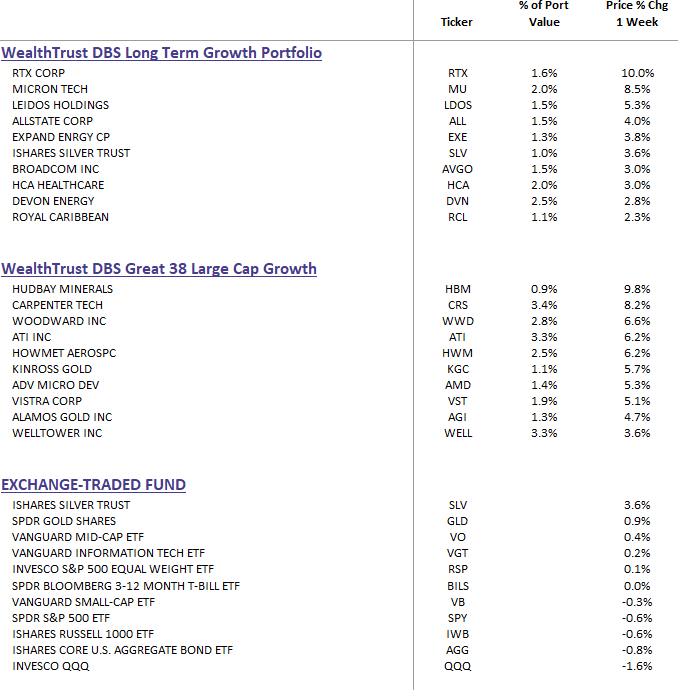
The S&P 500 closed the week modestly lower after testing levels around 7,400–7,500, remaining within roughly 3% of its recent all-time high. Breadth was mixed. Energy and materials showed relative strength on the back of oil price volatility, while technology and communication services faced renewed scrutiny after earlier momentum faded. The Nasdaq continued to lag the broader market on a weekly basis as investors reassessed the near-term trajectory of artificial intelligence capital spending returns.
This is not a market in freefall. It is a market digesting strong year-to-date gains, absorbing geopolitical noise, and preparing for a concentrated cluster of high-stakes data and corporate reports.
Geopolitical Backdrop and Energy Markets
The Strait of Hormuz remains a live variable. Intermittent escalations between the United States and Iran, including attacks on commercial shipping and temporary disruptions, have kept a risk premium embedded in crude prices. Oil has been volatile—earlier peaks above $100 have moderated, yet prices remain sensitive to every headline out of the Gulf. Even with partial restoration of traffic and increased production from non-Gulf sources, the market has not fully normalized the supply risk.
Higher energy costs feed directly into inflation expectations and corporate margin pressure for energy-intensive industries. They also complicate the Federal Reserve’s already delicate balancing act. At the same time, the energy sector’s relative outperformance this month underscores a broader theme we have highlighted for several quarters: leadership is rotating. Pure-play AI and semiconductor names that dominated earlier in the year are no longer the only drivers. Financials, industrials, and select old-economy names have shown improving relative strength as investors seek diversification beyond the narrowest cohort of mega-cap growth stocks.
The Federal Reserve and the Path of Rates
The FOMC meets July 28–29. Consensus expects the target range for the federal funds rate to remain at 3.50%–3.75%, where it has sat since the beginning of the year. Markets assign low odds to an immediate hike, though the probability of at least one increase later in 2026 has risen as energy prices and sticky services inflation keep the door open.
Inflation has cooled from earlier peaks but remains above the Fed’s 2% objective. June CPI printed near 3.5% year-over-year, with core measures still elevated. The Committee continues to emphasize data dependence. Any signal that policymakers are growing more concerned about second-round effects from energy or wage pressures would likely pressure equity valuations, particularly among the highest-duration growth names.
Our quantitative framework continues to treat the interest-rate path as a secondary input. Primary signals remain earnings revisions, estimate momentum, and fundamental quality. Rate uncertainty raises the cost of capital and can compress multiples, but sustained upward revisions in corporate earnings have historically been the more reliable driver of intermediate-term returns.
Earnings Season: The Real Test of the AI Narrative
Q2 reporting is in full swing. Blended earnings growth for the S&P 500 has tracked well above initial expectations—recent estimates place the growth rate in the mid-to-high 30% range, aided by strong results and some large one-time items. Revenue growth has also held up better than feared.
The coming week carries outsized importance. Microsoft and Meta report after the close on Wednesday; Apple and Amazon follow on Thursday. These four companies, together with the broader Magnificent 7 cohort, account for a disproportionate share of index earnings growth and market capitalization. Investors will focus less on the headline beats and more on three questions:
- Is AI-related capital expenditure still accelerating, and is it beginning to generate measurable incremental revenue and margin contribution?
- How are advertising, cloud, and consumer spending trends holding up against a backdrop of higher energy prices and elevated borrowing costs?
- Are forward guidance and analyst estimate revisions moving higher or lower after the reports?
Our process places particular weight on the direction of earnings estimate revisions in the weeks following these releases. Positive revisions across a broader set of companies—not just the largest platforms—have historically correlated with better intermediate-term market breadth and lower risk of sharp drawdowns. Conversely, a cluster of downward revisions or cautious commentary on AI monetization would reinforce the case for a more defensive posture and greater emphasis on companies with visible earnings visibility outside the pure AI theme.
We continue to integrate AI momentum screening as a support layer within a disciplined quantitative and fundamental process, not as a standalone strategy. The goal is to identify durable earnings acceleration while maintaining clear sell rules when revisions deteriorate.
Portfolio Implications and Process Discipline
The current environment favors active management with explicit risk controls. Passive exposure to the largest indices concentrates risk in a handful of names whose valuations and narrative sensitivity remain elevated. Our approach emphasizes:
- Earnings revision momentum as a primary buy and sell signal.
- Sector and factor diversification that captures rotation without abandoning quality.
- Downside protection through position sizing and predefined exit criteria.
- A hybrid of quantitative screens and fundamental verification, refined over more than two decades of live market application.
We remain constructive on the longer-term trajectory of corporate earnings, particularly among companies demonstrating consistent upward estimate revisions and strong free-cash-flow generation. Near-term volatility around the Fed decision and mega-cap reports is expected and, in our view, creates opportunity for disciplined allocation rather than wholesale risk reduction.
International and emerging-market equities have contributed positively in recent periods, aided by semiconductor and technology exposure outside the United States. Selective exposure there continues to offer diversification benefits when domestic leadership narrows.
Looking Ahead
The next two weeks will deliver a dense calendar of information: the FOMC statement and press conference, the bulk of Magnificent 7 results, additional economic data on inflation and activity, and ongoing geopolitical developments in the Middle East. Markets rarely move in a straight line through such periods. Short-term price action will likely remain choppy.
Our framework does not require perfect foresight on rates or oil prices. It requires consistent application of earnings-based signals, attention to changing leadership, and the willingness to adjust when the data change. That process has produced outperformance versus the broader market in a majority of periods over the long term, with particular value during transitions when narrative and fundamentals diverge.
As always, the objective is not to eliminate uncertainty—that is impossible—but to manage it in a way that allows clients to remain invested through the noise. Disciplined active management, grounded in numbers rather than stories, remains the most reliable path we know toward that outcome.
John G. McHugh President & Chief Investment Officer WealthTrust Asset Management LLC
This commentary is for informational purposes only and does not constitute investment advice. Past performance is not indicative of future results. Strategies mentioned may not be suitable for all investors. Please contact us for strategy-specific disclosures, including GIPS-verified performance information available to qualified investors.