

Weekly Market Commentary - Week Ending Saturday, September 26, 2026
The Tape Held. The Cost of Capital Did Not Stay Quiet.
U.S. equities finished a volatile week higher, but the story was not a clean risk-on rally. It was a repricing of two different clocks: earnings and AI capex on one side, and the cost of money and energy on the other.
The S&P 500 closed Friday at 7,743.41, up 0.51% on the day and about 1.2% for the week, still within roughly 1% of last month’s record. The Nasdaq Composite finished at 27,068.72, up 0.48% Friday and about 2.1% for the week. The Dow Jones Industrial Average rose 0.93% Friday to 51,828.62 and eked out a 0.3% weekly gain after two much weaker weeks. The Russell 2000 barely participated, finishing Friday at 2,837.55 and down about 0.8% for the week. Year to date, the scoreboard still favors growth: S&P 500 about +13.1%, Nasdaq about +16.5%, Dow about +7.8%.
That mix matters. Large-cap growth and AI infrastructure absorbed the bond shock. Breadth did not. Small caps, energy, and rate-sensitive cyclicals did more of the work of digesting higher long-term yields.
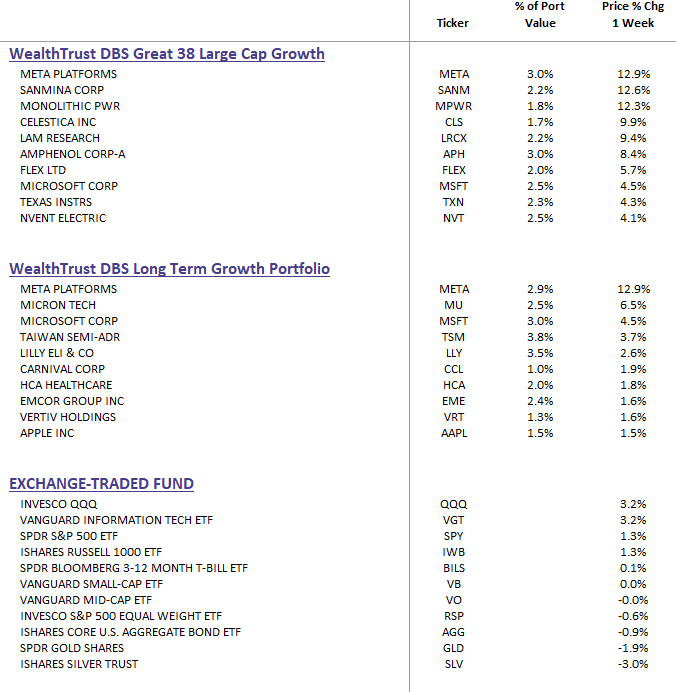
DBS Great 38 Large Cap Growth & DBS Long-Term Growth Top Ten and Benchmark Weekly Performance Summary
What Actually Moved Prices
Three forces ran the week.
First, Treasury yields. The 10-year note touched about 5.23%—levels last seen in 2007—before settling near 5.18%. The 30-year yield printed near 5.5%, a 22-year high, before easing slightly. The two-year finished closer to 4.86%. That is not a garden-variety backup in rates. It is the market restating that policy is no longer drifting toward easier money.
Second, oil. Brent spent the week oscillating around the $100 handle and finished lower Friday on unconfirmed reports that U.S. and Iranian negotiators were exploring a path to reopen the Strait of Hormuz. WTI settled near $92. Energy stocks lagged as crude gave back midweek gains. The oil market is still a geopolitical market. It is not a demand-collapse market.
Third, AI leadership. Information technology was the best S&P 500 sector for the week, up about 3.1%. Meta’s Muse agent and related AI-product news helped power a double-digit weekly gain in the name. Semiconductors, special industrial machinery, and testing/measurement equipment led Friday’s tape. Microsoft advanced after plans to combine consumer and workplace Copilot into a corporate product. That is earnings-visibility buying, not slogan buying.
The VIX finished near 14.9. That is not a fear market. It is a market that has chosen to treat long-duration yields as a valuation tax rather than a crash catalyst—so far.
The Fed Has Already Spoken. This Week Was the Echo.
The September 16 FOMC decision is still the policy anchor. The Committee raised the funds rate 25 basis points to 3.75%–4.00%—the first hike in three years—on a unanimous vote under Chair Kevin Warsh. The statement was blunt: inflation remains elevated, and the Committee “will deliver price stability.” The median dot implies a year-end funds rate near 4.1%, which is another hike before December. Growth and inflation projections were revised up, not down. Unemployment was marked near 4.1%.
This week’s speeches confirmed the direction. Officials, including New York Fed President John Williams, said another hike this year is reasonable if inflation does not cool. Futures still assign a high probability to at least one more move in 2026. That is why the long end of the curve, not the overnight rate, did the damage. The hike was priced. The terminal rate and the duration of “higher for longer” were not fully digested.
For active managers, this is not a mystery. Rising discount rates compress multiples first and earnings later. The companies that keep multiples are the ones still winning estimate revisions. The companies that lose multiples are the ones whose growth was only a story.
The Economy Is Not Rolling Over. It Is Running Hot Enough to Keep the Fed Honest.
September flash PMIs were the week’s most important growth print. The U.S. Composite PMI jumped to 58.4, a multi-year high, with both services and manufacturing expanding. Input-price inflation in the survey hit its highest reading since late 2022. That combination—strong activity plus sticky costs—is exactly why the long bond sold off.
Other data were mixed but not recessionary. Durable goods orders were essentially flat versus a modest decline expected. New-home sales rose in August. Final University of Michigan sentiment ticked up to 48.1—still depressed, but not collapsing. Unemployment remains near 4.1%. Next Friday’s September payrolls report is the next hard labor checkpoint; consensus is still looking for roughly 100,000 jobs and stable unemployment.
Q2 GDP printed 1.5% annualized. That is slower than the first quarter, but it is not a stall. Business investment tied to AI infrastructure continues to do more work than the headline implies. The U.S. is also a net energy exporter, which is why a Hormuz shock hurts less than it would have a decade ago—even if diesel and freight costs still feed into core inflation with a lag.
Diplomacy Moved the Headlines. It Has Not Yet Moved the Barrels.
The Trump–Xi meetings in Washington produced language markets wanted to hear: a new dialogue on advanced AI, opposition to tolls on international waterways, limited tariff relief on roughly $30 billion of non-sensitive goods each way, and additional commodity purchase talk. Trump called the meeting “great.” Markets treated it as constructive, not transformative.
Oil still trades on whether tankers actually transit Hormuz, not on joint statements. Reports of a possible phased reopening helped Friday’s equity bounce and the oil pullback. Those reports remain unconfirmed. Until barrels clear the strait in size, energy is a volatility input, not a solved problem.
That distinction is important for portfolio construction. Geopolitical relief rallies fade when the physical market does not confirm them. Estimate revisions in energy producers, refiners, and industrial users will tell us faster than any communiqué whether the shock is fading or embedding.
What Leadership Is Telling Us
The week’s internal tape is consistent with a market that still pays for visible earnings power and visible capex demand.
Winners: semiconductors, AI infrastructure, selected industrials tied to power, cooling, and factory automation, and some financials that benefit from a steeper, higher curve.
Laggards: oil equities on the Friday crude drop, telecom, and smaller-cap cyclicals that feel the 10-year more than they feel a Muse headline.
That is not “the market is broken.” It is concentration doing what concentration does when the discount rate rises. The S&P 500 can print a green week while fewer stocks do the lifting. We watch participation, not just the index. A durable advance needs estimate revisions to broaden beyond the same handful of mega-cap compounders. A fragile advance does not.
How We Are Thinking About Portfolios
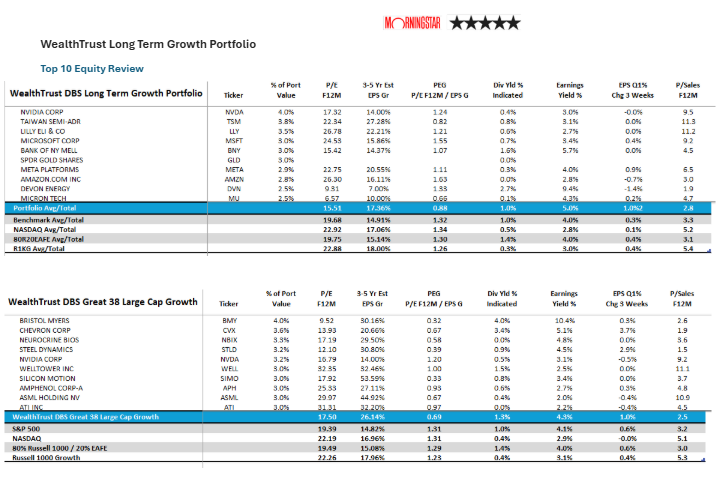
WealthTrust’s process does not start with a Fed narrative or a summit readout. It starts with numbers: earnings revisions, estimate dispersion, surprise history, and trend. When those signals deteriorate, we sell. When they improve and valuations are still reasonable, we hold or add. That discipline is why we did not treat 2022’s growth drawdown as a personality test, and it is why we will not treat a 5% 10-year as a reason to abandon companies still raising numbers.
Several implications follow from this week:
- Duration risk is real again. A 5.2% 10-year and a 5.5% 30-year change the hurdle rate for long-duration growth stories that are not growing fast enough. Multiple compression is the first tax. Earnings disappointment is the second.
- AI is still an earnings cycle, not a slogan cycle. The names that worked this week were tied to product launches, capex visibility, and semiconductor demand. That can persist even with higher rates if revisions stay positive. It cannot persist if capex is only a press release.
- Small-cap and equal-weight leadership has not confirmed. The Russell 2000’s weekly decline versus Nasdaq strength is a warning, not a footnote. Breadth has to improve before we treat this as a broad risk-on regime.
- Energy is a hedge and a risk, not a religion. A Hormuz deal would take the inflation spike off the table and help the long bond. No deal keeps a tail on core inflation and on the Fed’s next hike. Position size should reflect that binary, not a forecast of which headline wins Friday.
- Cash and quality still have a job. With the policy rate at 3.75%–4.00% and another hike on the table, the opportunity cost of owning low-quality balance sheets is higher than it was in the cutting cycle. Sell rules exist for this tape.
The Week Ahead
Investors will get September consumer confidence, then Friday’s employment report. Later next week, attention turns to month-end inflation data and the first wave of fiscal-year-end and early Q3 earnings (Micron, Accenture, and others). The Fed is on the sidelines until late October, which means the data will do the talking.
The setup is straightforward. Growth is firm enough that the Fed does not have to ease. Inflation is high enough that the Fed does not have to stop. Equities can live with that combination if earnings keep being revised higher. They cannot live with it if revisions roll over while the 10-year stays above 5%.
This commentary is for informational purposes only and does not constitute investment advice, an offer to sell, or a solicitation to buy any security. Past performance is not indicative of future results. Investing involves risk, including possible loss of principal. Indexes are unmanaged and cannot be invested in directly.