

Weekly Market Commentary - Week Ending Saturday, September 19, 2026
A Split Tape After the First Hike in Three Years
Rates, oil, and earnings quality — not headlines — decided the week.
Markets spent this week doing what they often do when two powerful forces collide: they priced the policy shock first, then they priced the earnings reality. The Federal Reserve delivered its first rate increase since July 2023. Crude spent the week above $100. The 10-year Treasury yield crossed 5% again. And yet the Nasdaq finished higher, healthcare led the S&P 500, and the cap-weighted market barely budged. That is not a panic tape. It is a discriminating tape.
The scoreboard for the week ending September 18 tells the story in four numbers. The Dow Jones Industrial Average fell 1.7% to 51,682.64 — its third consecutive weekly decline and its worst week since March. The S&P 500 slipped 0.03% to 7,650.50, down for a second straight week and still 1.9% below its August 13 record close of 7,798.99. The Nasdaq Composite rose 0.7% to 26,522.55. The Russell 2000 dropped 1.5%. Year to date, the S&P 500 is up 11.8%, the Nasdaq 14.1%, the Dow 7.5%, and the Russell 2000 15.2%.
The daily path of the S&P 500 made the week
’s split personality obvious:
Monday, September 14: −0.48% to 7,619.98
Tuesday, September 15: −0.45% to 7,585.73
Wednesday, September 16: −0.45% to 7,551.81 — the Fed day low, near the 100-day moving average
Thursday, September 17: +1.14% to 7,637.76 — the week’s repair session
Friday, September 18: +0.17% to 7,650.50 — a quiet close into quad-witching expiration
Equal-weight and small-cap indexes lagged the cap-weighted S&P 500. That is the market’s way of saying leadership is still concentrated even as sector leadership rotates. Technology and healthcare finished the week higher. Utilities, financials, real estate, and materials did not. Growth, as measured by the iShares Russell 1000 Growth ETF (IWF), rose about 0.8% on the week after a midweek washout — a reminder that the growth-versus-value debate this year has been a valuation and earnings-revision debate, not a slogan.
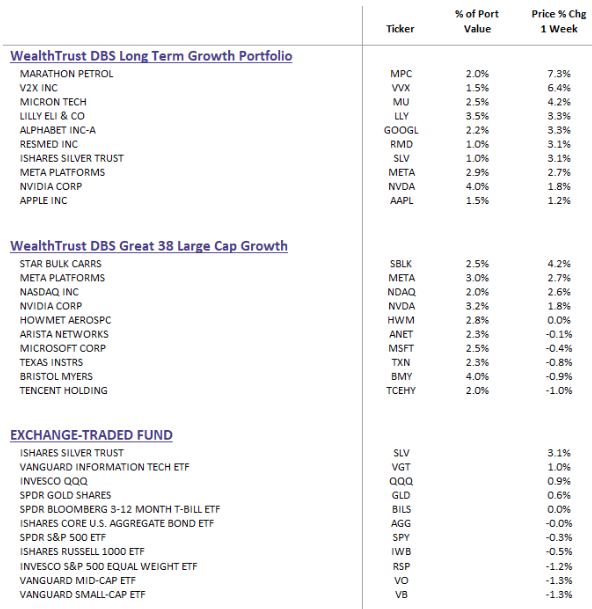
DBS Long-Term Growth & DBS Great 38 Large Cap Growth Top Ten and Benchmark Weekly Performance Summary
At a Glance
The Fed: A Dose of Accommodation Removed
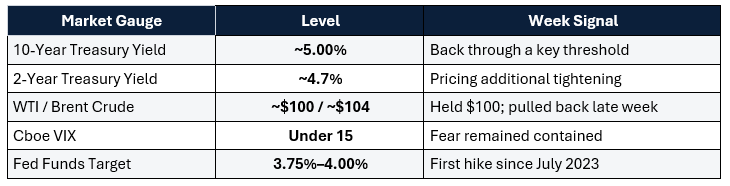
On Wednesday the Federal Open Market Committee voted 12–0 to raise the federal funds target range by 25 basis points to 3.75%–4.00%. It was the first increase in three years and the first under Chairman Kevin Warsh. The decision itself was widely expected. The language around it was not treated as routine.
Warsh’s press conference was short by modern Fed standards — about 30 minutes, with no follow-up questions — and that brevity was part of the message. He said the Committee was “hard pressed to describe broad financial conditions as restrictive,” and therefore “removed a dose of accommodation.” That phrase is doing a lot of work. It frames current policy as still easy, not tight. It also leaves the door open to more action without committing the Committee to a pre-announced path. Warsh was explicit on that point: he is not in the forward-guidance business.
The Summary of Economic Projections filled in what the Chairman declined to telegraph. Median real GDP is projected at 2.3% this year and 2.4% next year. The unemployment rate is expected to hold near 4.1%. Total PCE inflation is projected at 3.7% this year, falling to 2.3% next year. The median participant sees the appropriate funds rate at 4.1% at year-end and still there at the end of 2027 — in other words, one more quarter-point move in 2026 and then a pause. Sixteen of eighteen participants who submitted dots expect at least one additional hike this year; four see two. Inflation risks were described as tilted to the upside. Labor-market risks were described as roughly balanced.
The statement itself was lean. Economic activity is expanding at a solid pace. Domestic spending has been resilient. Productivity growth is strong and capital investment is robust. Job gains have kept pace with the workforce. Inflation remains elevated. “Today’s policy action will support a timelier return to the Committee’s 2 percent goal. The Committee will deliver price stability.” That last sentence is the one clients should keep. The Fed is no longer describing inflation as a fading supply shock. It is describing a problem that has lasted too long.
Markets initially sold the decision. The S&P 500 tagged support near 7,515 on Wednesday before recovering. By Friday, futures markets were pricing roughly a 55% chance of another hike at the October 27–28 meeting, up from the low-40s a week earlier and from single digits a month ago. The probability of additional tightening by December was near 90%. That is a material reset in the rate path — and it is why the 10-year yield spent the back half of the week back at 5%.
Our read is straightforward. A 25-basis-point hike does not break this economy. A 5% 10-year yield does reprice duration-sensitive assets, housing-adjacent names, and companies that need the capital markets. The labor market can absorb this. Weekly initial jobless claims fell to approximately 196,000 — levels last seen in 1969 — and continuing claims remain well below any stress threshold. The question is not whether the economy is collapsing. It is whether oil-driven inflation is allowed to broaden into wages and core services. That is the risk the Fed is targeting.
Oil, Hormuz, and the Inflation Overlay
Energy remains the inflation wildcard. Brent spent parts of the week near $110 before settling near $104. West Texas Intermediate held around $100. Those are not 2022 spike levels, but they are high enough to keep headline inflation sticky and to keep the Fed on a tightening bias. The source is not a demand boom. It is supply risk that has been with this market since the U.S.–Iran conflict began on February 28.
The week’s oil tape was two-sided. Early-week pressure came from the ongoing war, Houthi activity, and reports of damage to Saudi Arabia’s East-West pipeline — the principal alternative route that lets Saudi crude reach the Red Sea without transiting the Strait of Hormuz. Late-week relief came from signs that some of that capacity could return and from a pullback after two weeks of gains. That is how this market has traded for months: a spike on disruption headlines, a fade when an alternative route or a diplomatic meeting appears, then another spike when the ceasefire frays.
Investors should not confuse a three-day oil pullback with a solved energy problem. Confidence in the Strait of Hormuz, once broken, is slow to rebuild. Freight rates on Middle East–China VLCCs have been a large share of the delivered crude price. Insurance, convoy requirements, and the simple willingness of shipowners to send hulls back into the Gulf all matter as much as the headline barrel price. Until those frictions fade, $100 oil is a feature of the inflation backdrop, not a one-week event.
That is also why energy equities did not rally with the crude price this week. The Energy Select Sector SPDR finished down about 1.3%. Markets are distinguishing between a geopolitical risk premium in the commodity and the earnings power of the companies. We will continue to treat energy as ballast and as an earnings-revision story — not as a momentum chase on every Hormuz headline.
A Tale of Two Markets: What Led, What Lagged
Sector performance this week was the cleanest expression of the rate-and-oil shock. Using sector SPDRs as a guide, healthcare gained about 1.8% and information technology about 1.0%. Utilities fell about 3.1%, financials about 2.4%, real estate about 2.1%, materials about 1.9%, consumer discretionary about 1.7%, communication services and industrials in the mid-1% range, energy about 1.3%, and consumer staples less than 1%.
That ranking is coherent. Higher long rates punish utilities and REITs. A hawkish Fed and a steeper front end punish rate-sensitive financials that had been priced for an easier path. Technology held up because the AI capex cycle has not been canceled by 25 basis points. Semiconductors, memory, and storage names — Broadcom, Micron, Sandisk, Seagate, Lam Research — provided the week’s real bid. Jensen Huang’s comment that Nvidia expects to sell twice as many chips next year is the kind of demand signal that still overwhelms a quarter-point hike.
Healthcare’s leadership deserves more attention than it received in the headlines. When the tape is noisy and duration is being repriced, investors look for earnings that are less hostage to the 10-year yield and less hostage to a single AI multiple. That rotation is consistent with what we have been seeing for several weeks: leadership broader than the AI headlines, even when the Nasdaq is the only major index finishing green.
The week also produced two idiosyncratic tape bombs that tell you where speculative capital still lives. Coinbase jumped about 12% and Robinhood about 9% after the SEC created a five-year exemption allowing certain platforms to offer tokenized stocks with shareholder rights. Bitcoin firmed into the weekend. We note the development. We do not build portfolios around regulatory exemptions. Tokenization may change market structure over a cycle. It does not change earnings revisions this quarter.
Warren Buffett, 96, stepped down as chairman of Berkshire Hathaway and became chairman emeritus. His son Howard was elected chairman. Greg Abel remains CEO. The market shrugged, which is itself a compliment to the succession plan. Father Time always wins. Institutions that plan for that fact sleep better than institutions that do not.
Earnings Revisions Still Matter More Than the Fed Dot Plot
This is the part of the week that does not fit in a headline, and it is the part that drives our process. A Fed hike changes the discount rate. Earnings revisions change the numerator. Over full cycles, the numerator wins.
The market that finished this week higher in technology and healthcare was not a market that abandoned quality. It was a market that paid up for visible demand — AI infrastructure, memory tightness, and healthcare cash flows — and marked down the balance-sheet and duration stories. That is an earnings-revision tape wearing a macro costume.
Russell 1000 Growth has had a more difficult 2026 than the last several years of dominance would have predicted. The iShares Russell 1000 Growth ETF is up only about 3.8% year to date even as the Nasdaq Composite is up 14.1%. That gap is concentration, construction, and the fact that a handful of mega-cap names no longer lift every growth benchmark in lockstep. It is also why we have spent much of this year talking about diversified growth, equal-weight behavior, and the Great 38 discipline rather than a single-factor bet on last year’s winners.
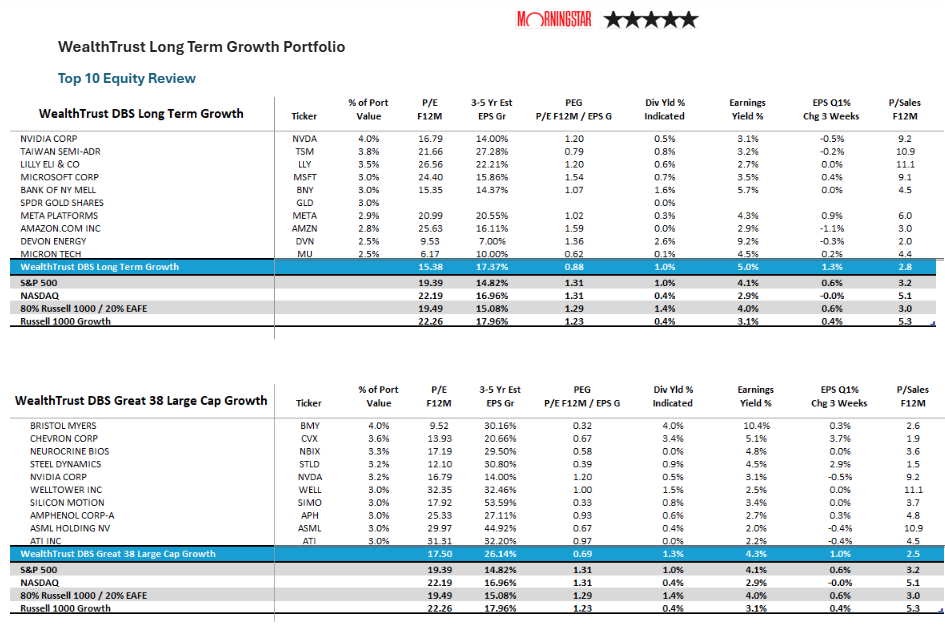
Our quantitative framework continues to emphasize three things: the direction of earnings estimate revisions, the persistence of relative strength only when it is confirmed by those revisions, and valuation as a risk overlay rather than a religion. When oil and yields jump in the same week, the framework does not ask us to become macro traders. It asks us whether the companies we own can still deliver the earnings path we underwrote — and whether any new names now screen as improving after the shakeout.
That is also why we do not treat a 0.08% decline in the S&P 500 as a verdict. Breadth was poor. Most stocks fell. Mid-caps and small-caps lagged. The equal-weight S&P was weaker than the cap-weighted index. Those are facts. They are also the conditions in which active selection has a job to do. Passive ownership of the whole index forces you to own the utilities that got hit by 5% yields and the financials that got hit by a hawkish Warsh press conference. An earnings-revision process does not.
How We Are Positioned
We entered the week with the same posture we have carried through this Iran-oil-Fed sequence: respect the inflation overlay, do not abandon the earnings cycle, and keep sell rules live. For example, our quantitative analysis projected a potential earning miss for Netflix and was verified by Wells Farge's dropping their rating to sell - therefore it was sold out of our DBS Long Term Growth Strategy.
Technology remains a core holding where estimate revisions and AI infrastructure demand are still improving. We are not indiscriminate. We prefer the picks-and-shovels of the buildout — semiconductors, networking, power, and storage — over narrative software that needs lower rates to justify the multiple. This week’s chip strength and software selectivity fit that distinction.
Healthcare’s relative strength is consistent with our process. When policy uncertainty rises, cash-flow visibility rises in value. We will not chase the sector simply because it led for five sessions. We will stay with the names whose revision trends confirm the move.
Energy is a risk-management allocation, not a trade. Oil above $100 is inflationary for the economy and supportive for the right producers and service companies. It is not a reason to concentrate a portfolio in a single geopolitical outcome. Financials require more selectivity after this week. Higher rates help net interest margins at the right banks and hurt the duration-heavy corners of the group. We will let revisions, not the sector label, make that cut.
What we will not do is rebuild the portfolio around the next FOMC date. October 27–28 is on the calendar. So is every other data print between now and then. Trends matter. Data points are noisy. That line from Chairman Warsh is one we can agree with — and it is how a numbers-first process is supposed to operate.
The Fed: A Dose of Accommodation Removed
On Wednesday the Federal Open Market Committee voted 12–0 to raise the federal funds target range by 25 basis points to 3.75%–4.00%. It was the first increase in three years and the first under Chairman Kevin Warsh. The decision itself was widely expected. The language around it was not treated as routine.
Warsh’s press conference was short by modern Fed standards — about 30 minutes, with no follow-up questions — and that brevity was part of the message. He said the Committee was “hard pressed to describe broad financial conditions as restrictive,” and therefore “removed a dose of accommodation.” That phrase is doing a lot of work. It frames current policy as still easy, not tight. It also leaves the door open to more action without committing the Committee to a pre-announced path. Warsh was explicit on that point: he is not in the forward-guidance business.
The Summary of Economic Projections filled in what the Chairman declined to telegraph. Median real GDP is projected at 2.3% this year and 2.4% next year. The unemployment rate is expected to hold near 4.1%. Total PCE inflation is projected at 3.7% this year, falling to 2.3% next year. The median participant sees the appropriate funds rate at 4.1% at year-end and still there at the end of 2027 — in other words, one more quarter-point move in 2026 and then a pause. Sixteen of eighteen participants who submitted dots expect at least one additional hike this year; four see two. Inflation risks were described as tilted to the upside. Labor-market risks were described as roughly balanced.
The statement itself was lean. Economic activity is expanding at a solid pace. Domestic spending has been resilient. Productivity growth is strong and capital investment is robust. Job gains have kept pace with the workforce. Inflation remains elevated. “Today’s policy action will support a timelier return to the Committee’s 2 percent goal. The Committee will deliver price stability.” That last sentence is the one clients should keep. The Fed is no longer describing inflation as a fading supply shock. It is describing a problem that has lasted too long.
Markets initially sold the decision. The S&P 500 tagged support near 7,515 on Wednesday before recovering. By Friday, futures markets were pricing roughly a 55% chance of another hike at the October 27–28 meeting, up from the low-40s a week earlier and from single digits a month ago. The probability of additional tightening by December was near 90%. That is a material reset in the rate path — and it is why the 10-year yield spent the back half of the week back at 5%.
Our read is straightforward. A 25-basis-point hike does not break this economy. A 5% 10-year yield does reprice duration-sensitive assets, housing-adjacent names, and companies that need the capital markets. The labor market can absorb this. Weekly initial jobless claims fell to approximately 196,000 — levels last seen in 1969 — and continuing claims remain well below any stress threshold. The question is not whether the economy is collapsing. It is whether oil-driven inflation is allowed to broaden into wages and core services. That is the risk the Fed is targeting.
Oil, Hormuz, and the Inflation Overlay
Energy remains the inflation wildcard. Brent spent parts of the week near $110 before settling near $104. West Texas Intermediate held around $100. Those are not 2022 spike levels, but they are high enough to keep headline inflation sticky and to keep the Fed on a tightening bias. The source is not a demand boom. It is supply risk that has been with this market since the U.S.–Iran conflict began on February 28.
The week’s oil tape was two-sided. Early-week pressure came from the ongoing war, Houthi activity, and reports of damage to Saudi Arabia’s East-West pipeline — the principal alternative route that lets Saudi crude reach the Red Sea without transiting the Strait of Hormuz. Late-week relief came from signs that some of that capacity could return and from a pullback after two weeks of gains. That is how this market has traded for months: a spike on disruption headlines, a fade when an alternative route or a diplomatic meeting appears, then another spike when the ceasefire frays.
Investors should not confuse a three-day oil pullback with a solved energy problem. Confidence in the Strait of Hormuz, once broken, is slow to rebuild. Freight rates on Middle East–China VLCCs have been a large share of the delivered crude price. Insurance, convoy requirements, and the simple willingness of shipowners to send hulls back into the Gulf all matter as much as the headline barrel price. Until those frictions fade, $100 oil is a feature of the inflation backdrop, not a one-week event.
That is also why energy equities did not rally with the crude price this week. The Energy Select Sector SPDR finished down about 1.3%. Markets are distinguishing between a geopolitical risk premium in the commodity and the earnings power of the companies. We will continue to treat energy as ballast and as an earnings-revision story — not as a momentum chase on every Hormuz headline.
A Tale of Two Markets: What Led, What Lagged
Sector performance this week was the cleanest expression of the rate-and-oil shock. Using sector SPDRs as a guide, healthcare gained about 1.8% and information technology about 1.0%. Utilities fell about 3.1%, financials about 2.4%, real estate about 2.1%, materials about 1.9%, consumer discretionary about 1.7%, communication services and industrials in the mid-1% range, energy about 1.3%, and consumer staples less than 1%.
That ranking is coherent. Higher long rates punish utilities and REITs. A hawkish Fed and a steeper front end punish rate-sensitive financials that had been priced for an easier path. Technology held up because the AI capex cycle has not been canceled by 25 basis points. Semiconductors, memory, and storage names — Broadcom, Micron, Sandisk, Seagate, Lam Research — provided the week’s real bid. Jensen Huang’s comment that Nvidia expects to sell twice as many chips next year is the kind of demand signal that still overwhelms a quarter-point hike.
Healthcare’s leadership deserves more attention than it received in the headlines. When the tape is noisy and duration is being repriced, investors look for earnings that are less hostage to the 10-year yield and less hostage to a single AI multiple. That rotation is consistent with what we have been seeing for several weeks: leadership broader than the AI headlines, even when the Nasdaq is the only major index finishing green.
The week also produced two idiosyncratic tape bombs that tell you where speculative capital still lives. Coinbase jumped about 12% and Robinhood about 9% after the SEC created a five-year exemption allowing certain platforms to offer tokenized stocks with shareholder rights. Bitcoin firmed into the weekend. We note the development. We do not build portfolios around regulatory exemptions. Tokenization may change market structure over a cycle. It does not change earnings revisions this quarter.
Warren Buffett, 96, stepped down as chairman of Berkshire Hathaway and became chairman emeritus. His son Howard was elected chairman. Greg Abel remains CEO. The market shrugged, which is itself a compliment to the succession plan. Father Time always wins. Institutions that plan for that fact sleep better than institutions that do not.
Earnings Revisions Still Matter More Than the Fed Dot Plot
This is the part of the week that does not fit in a headline, and it is the part that drives our process. A Fed hike changes the discount rate. Earnings revisions change the numerator. Over full cycles, the numerator wins.
The market that finished this week higher in technology and healthcare was not a market that abandoned quality. It was a market that paid up for visible demand — AI infrastructure, memory tightness, and healthcare cash flows — and marked down the balance-sheet and duration stories. That is an earnings-revision tape wearing a macro costume.
Russell 1000 Growth has had a more difficult 2026 than the last several years of dominance would have predicted. The iShares Russell 1000 Growth ETF is up only about 3.8% year to date even as the Nasdaq Composite is up 14.1%. That gap is concentration, construction, and the fact that a handful of mega-cap names no longer lift every growth benchmark in lockstep. It is also why we have spent much of this year talking about diversified growth, equal-weight behavior, and the Great 38 discipline rather than a single-factor bet on last year’s winners.
Our quantitative framework continues to emphasize three things: the direction of earnings estimate revisions, the persistence of relative strength only when it is confirmed by those revisions, and valuation as a risk overlay rather than a religion. When oil and yields jump in the same week, the framework does not ask us to become macro traders. It asks us whether the companies we own can still deliver the earnings path we underwrote — and whether any new names now screen as improving after the shakeout.
That is also why we do not treat a 0.08% decline in the S&P 500 as a verdict. Breadth was poor. Most stocks fell. Mid-caps and small-caps lagged. The equal-weight S&P was weaker than the cap-weighted index. Those are facts. They are also the conditions in which active selection has a job to do. Passive ownership of the whole index forces you to own the utilities that got hit by 5% yields and the financials that got hit by a hawkish Warsh press conference. An earnings-revision process does not.
How We Are Positioned
We entered the week with the same posture we have carried through this Iran-oil-Fed sequence: respect the inflation overlay, do not abandon the earnings cycle, and keep sell rules live. For example, our quantitative analysis projected a potential earning miss for Netflix and was verified by Wells Farge's dropping their rating to sell - therefore it was sold out of our DBS Long Term Growth Strategy.
Technology remains a core holding where estimate revisions and AI infrastructure demand are still improving. We are not indiscriminate. We prefer the picks-and-shovels of the buildout — semiconductors, networking, power, and storage — over narrative software that needs lower rates to justify the multiple. This week’s chip strength and software selectivity fit that distinction.
Healthcare’s relative strength is consistent with our process. When policy uncertainty rises, cash-flow visibility rises in value. We will not chase the sector simply because it led for five sessions. We will stay with the names whose revision trends confirm the move.
Energy is a risk-management allocation, not a trade. Oil above $100 is inflationary for the economy and supportive for the right producers and service companies. It is not a reason to concentrate a portfolio in a single geopolitical outcome. Financials require more selectivity after this week. Higher rates help net interest margins at the right banks and hurt the duration-heavy corners of the group. We will let revisions, not the sector label, make that cut.
What we will not do is rebuild the portfolio around the next FOMC date. October 27–28 is on the calendar. So is every other data print between now and then. Trends matter. Data points are noisy. That line from Chairman Warsh is one we can agree with — and it is how a numbers-first process is supposed to operate.
Looking Ahead
Next week the calendar lightens on policy and stays heavy on incoming data and Fed-speak. Markets will parse speeches from FOMC members for clues on whether Wednesday’s hike was a one-and-done adjustment or the start of a short extra cycle. Flash PMIs, durable goods, and the usual claims series will test the “solid pace” language in the statement. Corporate calendars include names such as Costco, AutoZone, Cintas, Paychex, KB Home, and Darden — a useful cross-section of the consumer, the labor market, and housing.
The three variables that will matter more than any one print are unchanged:
Oil and the Strait. A durable move back below $90 would take pressure off the Fed. A renewed spike toward the week’s highs would do the opposite. Diplomacy remains a headline risk, not a portfolio foundation.
The 10-year yield. Acceptance of 5% as a new neighborhood changes mortgage rates, equity duration, and the relative appeal of high-quality bonds for new money. Rejection of 5% — a quick fade — would reopen the summer playbook.
Earnings revisions into Q3 reporting. The AI capex cycle is still the dominant fundamental. The question is whether that cycle is broadening into cash returns or remaining a concentrated multiple story. We will take our cue from estimate changes, not from index labels.
Abroad, the Bank of Japan raised its policy rate to 1.25%, a 31-year high. Other major central banks are also leaning against inflation. This is not a U.S.-only tightening impulse. It is a global one, with oil as the common denominator.
Closing Thoughts
A week that includes the first Fed hike in three years, $100 oil, a 5% 10-year, and a third down week for the Dow can sound like a reason to do something dramatic. It is not. Volatility of this kind is the market doing its job: repricing the cost of money and the cost of energy while continuing to pay for companies that can grow earnings through both.
The S&P 500 is still up nearly 12% on the year. The economy the Fed described on Wednesday is not a recession economy. Productivity is strong. Capital investment is robust. The labor market is tight enough that claims look like 1969. Inflation is the problem. Policy is now moving to treat it like one. That combination is uncomfortable for the indexes that are packed with rate-sensitive industrials and financials. It is navigable for a process that starts with earnings.
Our role at WealthTrust is unchanged. We own businesses with improving earnings trajectories. We manage risk with predefined sell rules. We use AI and quantitative screens as tools inside that framework, not as a substitute for judgment. We do not need the next week to be quiet. We need the companies in the portfolio to keep earning the right to stay there.
If you would like to review how the Great 38 Core, the Core/Growth Blend, or the WealthTrust DBS process is positioned for a higher-for-longer rate path and an oil-constrained inflation backdrop, I am always glad to walk through the holdings, the revision trends, and the risk overlays. The goal is the same one we started with: a portfolio you can live with — so you can sleep better at night.
Thank you for your continued trust.
John McHugh
President & Chief Investment Officer
WealthTrust Asset Management LLC
Destin, Florida
Important Disclosures
This commentary is for informational purposes only and does not constitute investment advice, an offer to sell, or a solicitation of an offer to buy any security. Past performance is not indicative of future results. All investments involve risk, including the possible loss of principal. Index performance is provided for comparison only and does not reflect the deduction of fees or expenses. It is not possible to invest directly in an index. Forward-looking statements reflect opinions as of the date of this commentary and are subject to change. GIPS-verified performance details for WealthTrust composites are available upon request for qualified investors. WealthTrust Asset Management LLC is a registered investment adviser. Registration does not imply a certain level of skill or training.