

Weekly Market Commentary - Week Ending Saturday, October 17, 2026
Market Rotation Creates New Opportunities: Earnings Growth, Diversification, and a Broadening Investment Landscape
Why changing market leadership may create attractive opportunities for disciplined investors.
Market Overview: A Changing Market Creates New Opportunities
Financial markets experienced a meaningful rotation this week as investors reassessed artificial intelligence, inflation, interest rates, and corporate earnings. While technology-oriented companies encountered selling pressure, several other areas of the market demonstrated resilience, suggesting that investment opportunities may be expanding beyond the companies that have dominated recent market performance.
The Nasdaq Composite declined 4.5% for the week, while the S&P 500 fell 1.9% and the Russell 2000 lost 3.0%. In contrast, the Dow Jones Industrial Average advanced 0.7%, demonstrating that investors were not abandoning equities altogether but were increasingly distinguishing among sectors, valuations, and earnings opportunities. We believe this distinction is important. After several years of exceptional performance from a relatively narrow group of technology companies, a broader market rotation could create opportunities for investors willing to look beyond the most popular investment themes. Periods of changing market leadership are a normal part of the investment cycle. Although they can create short-term volatility, they also provide opportunities to identify companies with attractive valuations, improving earnings expectations, and sustainable long-term growth prospects.
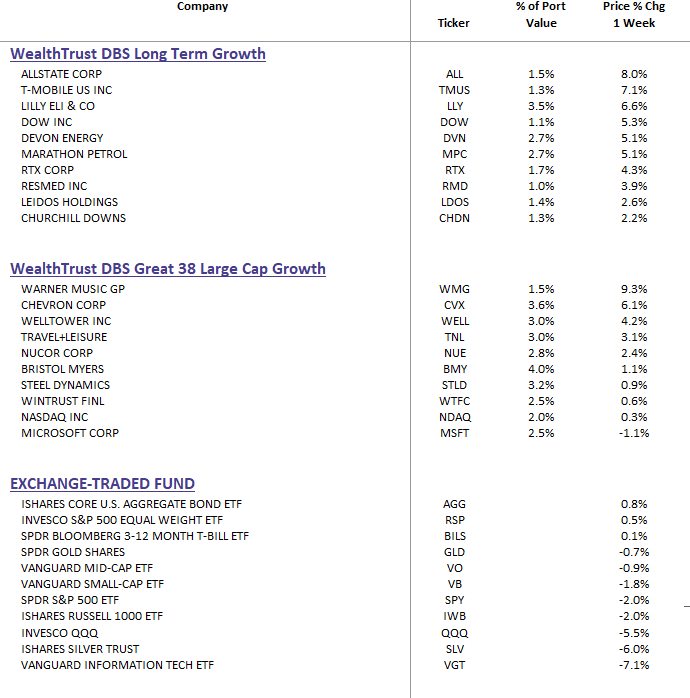
DBS Long-Term Growth & DBS Great 38 Large Cap Growth Top Ten and Benchmark Weekly Performance Summary
Artificial Intelligence: The Long-Term Growth Story Remains Compelling
Artificial intelligence remains one of the most significant technological developments of our generation. Its potential to improve productivity, reduce operating costs, and create new products and services extends across virtually every major industry. Healthcare, financial services, manufacturing, defense, logistics, and software development are already experiencing the effects of AI adoption. We believe the long-term economic opportunities associated with artificial intelligence remain substantial. However, the financial markets are beginning to distinguish more carefully between the technological promise of AI, and the valuations investors are willing to pay for companies participating in its development. Companies are committing significant resources to data centers, advanced computing equipment, networking systems, and electricity infrastructure. These investments may ultimately create substantial economic value, but investors increasingly want evidence that the associated revenue and earnings will justify the expenditures.
We view this development as a potentially healthy progression in the investment cycle. Rather than rewarding companies simply because they participate in artificial intelligence, investors may increasingly favor businesses demonstrating measurable improvements in profitability, cash flow, and earnings expectations.
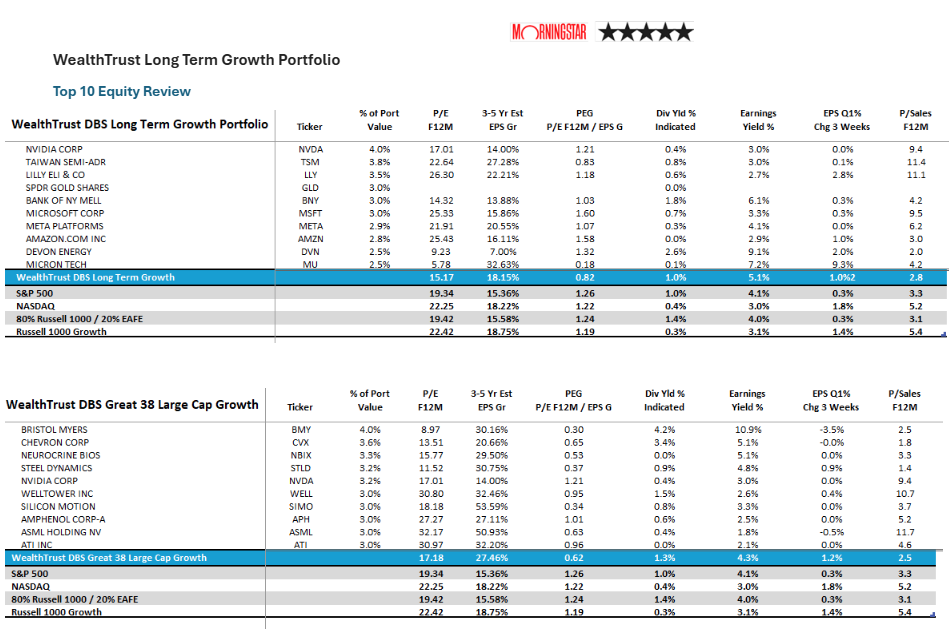
The WealthTrust DBS Long-Term Growth Strategy currently generates free cash flow of $8 per share and trades at a price-to-free-cash-flow ratio of 20.4x, compared with $5.3 and 42.6x for the Russell 1000 Growth Index, respectively demonstrating a more reasonably valued portfolio on a cash-flow basis. Also, a company experiencing strong earnings growth at a reasonable valuation may offer a more attractive investment opportunity than a business whose stock price already reflects exceptionally optimistic expectations.
We remain constructive on artificial intelligence, but believe the next phase of investment performance may increasingly reward earnings quality, financial discipline, and attractive valuations rather than enthusiasm alone.
Inflation and Interest Rates: Opportunities Beyond the Headlines
Inflation remained an important consideration this week following September's Consumer Price Index report, which showed prices increasing 3.7% over the preceding twelve months.
Although inflation remains above the Federal Reserve's long-term objective, the economy continues to demonstrate areas of resilience, and investors are increasingly evaluating how businesses can perform under a range of interest-rate environments.
The Federal Reserve's next policy meeting is scheduled for October 27–28, when policymakers will assess the balance between inflation, employment, and economic growth.
Higher interest rates present challenges, but they also create opportunities.
For example, elevated Treasury yields provide investors with more attractive income alternatives than were available during the prolonged period of exceptionally low interest rates.
Companies with strong balance sheets and limited borrowing requirements may also enjoy competitive advantages over more highly leveraged businesses.
In addition, higher financing costs can encourage greater corporate discipline, leading management teams to prioritize investments with attractive expected returns rather than pursuing growth regardless of cost.
We believe these developments may ultimately support more sustainable earnings growth.
While the timing of future Federal Reserve policy changes remains uncertain, investors should remember that attractive equity-market returns do not require interest rates to decline immediately.
Corporate profitability, productivity improvements, innovation, and improving earnings expectations can support investment opportunities even when monetary policy remains restrictive.
Our focus remains on identifying companies capable of delivering attractive earnings growth across different economic and interest-rate environments.
Treasury Yields: Income and Financial Flexibility
Treasury securities continued to attract investor interest during the week as market participants balanced inflation concerns against uncertainty surrounding economic growth.
The benchmark 10-year Treasury yield finished near 5.09%, providing a meaningful income alternative for investors.
Higher yields can create opportunities for investors seeking income, particularly through high-quality fixed-income securities.
We believe the ability to earn competitive yields while maintaining liquidity represents an important improvement from the extremely low interest-rate environment experienced during much of the previous decade.
Short-duration Treasury securities may provide an attractive combination of income, liquidity, and relatively limited sensitivity to interest-rate changes.
For diversified portfolios, these investments can serve several purposes.
They may provide stability during periods of equity-market volatility, generate income, and preserve flexibility to take advantage of attractive investment opportunities.
Importantly, liquidity should not be viewed simply as a defensive allocation.
Corporate Earnings: The Foundation for the Next Market Advance
Third-quarter earnings season is arriving at an important time, providing investors with an opportunity to evaluate the underlying strength of corporate America.
While market headlines frequently focus on interest rates, geopolitical developments, and short-term price movements, corporate earnings remain one of the most important drivers of long-term equity performance.
Companies that consistently increase profitability, generate strong cash flow, and improve their competitive positions can create substantial shareholder value over time.
We believe the current earnings season may help identify the next group of market leaders.
Major financial institutions have begun reporting results, offering insight into consumer activity, lending conditions, credit quality, and the broader economy.
Technology companies will provide additional information about artificial intelligence demand, capital spending, and the financial returns associated with innovation.
For investors, the most important information may not be the earnings reported for the previous quarter, but how expectations for future profitability are changing.
At WealthTrust, we place considerable emphasis on earnings estimate revisions.
When analysts increase their expectations for future earnings, it may indicate improving business conditions, stronger demand, expanding margins, or successful execution by management.
Companies experiencing these favorable developments can attract increasing investor interest.
Conversely, deteriorating earnings expectations may indicate that a company's business outlook is becoming less favorable.
We believe identifying these changes early is an important part of disciplined investment management.
The encouraging opportunity is that attractive earnings growth is not limited to a handful of technology companies.
Healthcare, financial services, industrials, energy, and selected consumer businesses may also offer compelling opportunities as economic conditions and investor preferences evolve.
A broader earnings recovery across multiple sectors could support a healthier and more diversified equity market.
The U.S. Economy: Resilience and Long-Term Growth Potential
Despite persistent inflation and elevated borrowing costs, the U.S. economy continues to demonstrate important sources of resilience.
American businesses remain innovative, technological investment continues, and productivity improvements may provide meaningful support for long-term economic growth.
Artificial intelligence, automation, advanced manufacturing, and improvements in energy infrastructure represent important areas of potential investment and productivity growth.
We believe these developments could create opportunities extending well beyond the technology sector.
The American economy has demonstrated an ability to adapt to changing conditions throughout its history.
We believe that adaptability, combined with innovation and entrepreneurship, remains an important foundation for long-term investment opportunities.
Diversification: A Broadening Market Could Benefit Investors
One of the most encouraging aspects of this week's market performance was the divergence between technology-oriented indexes and other segments of the equity market.
While the Nasdaq experienced substantial weakness, the Dow Jones Industrial Average finished the week higher.
This suggests investors were differentiating among businesses and sectors rather than indiscriminately selling equities.
A broadening market can create opportunities for disciplined investment managers to identify attractive companies that may have been overlooked while investor attention was concentrated on a relatively narrow group of market leaders.
WealthTrust's Investment Approach: Finding Opportunity Through Discipline
Our investment process evaluates a broad universe of publicly traded companies, seeking to identify businesses demonstrating favorable combinations of earnings growth, valuation, and market momentum.
A particularly important component involves monitoring revisions to analysts' future earnings estimates.
When earnings expectations improve, positive market trends may reflect strengthening business fundamentals.
When earnings expectations deteriorate, our process calls for reassessing the investment thesis. As an example, when we recently sold Netflix.
We place particular emphasis on valuation discipline. As Growth at a Reasonable Price manager, we have historically outperformed the Russell 1000 Growth Index during periods of
elevated valuations and more selective market conditions
Looking Ahead: Opportunities May Expand as Earnings Season Progresses
The coming weeks should provide valuable information about corporate profitability, artificial intelligence investment, and Federal Reserve policy.
We believe investors should pay particular attention to companies reporting improving earnings expectations, expanding margins, and favorable forward guidance.
Technology earnings will help determine whether AI-related spending continues translating into stronger business results.
Financial and industrial companies may provide additional insight into economic resilience and potential opportunities outside the technology sector.
We will also monitor Treasury yields, energy prices, and market breadth.
If additional sectors begin demonstrating improving earnings expectations and positive price momentum, the market could become less dependent on a narrow group of large technology companies.
We would view that development as constructive.
Although short-term volatility may continue, market corrections can create opportunities to purchase financially attractive businesses at valuations more favorable than those available during periods of excessive investor enthusiasm.
The key is maintaining a disciplined investment process rather than attempting to predict every short-term market movement.
Final Thoughts: A Constructive Outlook for Disciplined Investors
This week's market performance reminds us that changing market leadership is a normal part of investing.
While technology stocks experienced significant selling pressure, resilience in other market segments suggests that investors continue to find opportunities across the economy.
We remain constructive on the long-term prospects for American businesses, particularly those benefiting from innovation, productivity improvements, and sustainable earnings growth.
Artificial intelligence continues to offer extraordinary potential, but we believe attractive investment opportunities extend well beyond the technology sector.
A broader market, supported by improving earnings across multiple industries, could provide a healthier foundation for long-term equity performance.
At WealthTrust Asset Management, we believe periods of volatility can create opportunities for disciplined investors who focus on earnings fundamentals, reasonable valuations, and diversification.
Our objective is not to predict every market fluctuation, but to identify attractive investment opportunities while maintaining a consistent approach to risk management.
Our message to investors remains positive: Market rotations create opportunities. Diversification provides flexibility. And disciplined investing, supported by improving earnings expectations, remains a compelling approach to pursuing long-term growth.