

Weekly Market Commentary - Week Ending Saturday, November 7, 2026
This week, markets continued to trade around three big questions:
How close are we to rate cuts?
- How resilient is growth—especially the U.S. consumer?
- How sustainable is the AI and data‑center investment boom that has been driving parts of the equity market?
I’ll cover macro and markets first, then close with a brief look at data‑center financing and what we’re seeing in earnings.
Macro: Cooling, Not Crashing
Recent data still fit a “cooling but growing” U.S. backdrop:
Labor market
Initial jobless claims edged higher, pointing to a labor market that is loosening gradually rather than breaking. Job openings are down from peak levels, but layoffs remain historically low. Wage growth is slowing, but not yet at a pace fully consistent with 2% inflation.Inflation
The latest readings were broadly in line with expectations.Core inflation is trending lower, but services and shelter remain sticky.
- Markets remain hypersensitive to any upside surprise, since that could push out the timing of rate cuts.
Growth
High‑frequency indicators—credit card spending, business surveys, freight and mobility data—show slower momentum than earlier in the year, but no clear signal of imminent recession. Manufacturing is still soft, while services are moderating from elevated levels.
Bottom line: The soft‑landing narrative is intact for now: slower growth, gradually easing inflation, and no decisive break in the real economy.
Central Banks and Rates: “Higher for Longer” Still Rules
The Federal Reserve continues to stress data dependence, but the direction of travel is clear:
Futures markets still price rate cuts over the next 12–18 months, but on a flatter and later path than many hoped at the start of the year.
- Fed officials are pushing back on expectations for rapid easing, emphasizing the need for more confidence that inflation is durably headed to target.
- Other major central banks are in similar territory: off the peak of the hiking cycle, but reluctant to declare victory.
Market implication: We remain in a “higher for longer” rate regime compared with the 2010s. That continues to reshape valuations, financing costs, and sector leadership across equities and credit.
Equities: Choppy Tape, Narrow Leadership
Equity markets were volatile but range‑bound overall:
Index level
Major benchmarks had modest net moves, but there was more notable rotation beneath the surface.Leadership
Large‑cap tech and AI‑linked names remain the key drivers of index performance.
- Day‑to‑day, there’s more push and pull as investors debate whether earnings can keep up with current valuations.
Cyclicals vs defensives
Cyclicals (industrials, financials, consumer discretionary) traded mostly off shifting expectations for growth and rates.
- Defensives (utilities, staples, health care) provided ballast for investors looking to hedge against further growth deceleration.
Earnings revisions remain concentrated: companies tied to AI, automation, and digital infrastructure are generally seeing better estimate revisions than more traditional, rate‑sensitive businesses.
Fixed Income: Curve Still Inverted, Credit Still Complacent
Bond markets remain consistent with a late‑cycle environment:
Treasuries
Yields moved within a relatively tight band. The curve is still inverted—short rates above long rates—though less extremely than before. Historically, that points to slower growth ahead, but not necessarily an immediate downturn.Credit spreads
Investment‑grade and high‑yield spreads remain tighter than you might expect given macro uncertainty. That reflects:Solid corporate balance sheets, and
- Strong demand for yield in a world where cash and short‑term bonds now offer respectable returns.
Financing conditions
Banks remain more selective, especially commercial real estate and cyclical sectors, but capital markets are open for high‑quality borrowers. That’s particularly important for capital‑intensive areas like infrastructure and data centers.
AI, Data Centers, and What We’re Seeing in Earnings
A major part of this year’s equity narrative is the AI and digital‑infrastructure cycle. The visible piece is semiconductors and software; the less visible, but equally important, piece is data centers—large, power‑intensive facilities that host the computing required for AI and cloud services.
These projects are expensive and long‑lived, so they sit right at the intersection of growth expectations and higher financing costs.
At WealthTrust, we’ve seen this theme show up clearly in recent earnings:
Vertiv, Coherent, and Emcor—all in our SBS Long Term Growth Strategy and closely tied to data‑center and infrastructure spending—have delivered strong results this quarter, with upward estimate revisions going forward.
- That strength reflects:
Robust demand for power, cooling, and critical infrastructure inside data centers, and
- A pipeline of AI‑ and cloud‑related projects that are still building rather than peaking.
This earnings strength is an important confirmation that the data‑center build‑out isn’t just a story about headline AI names; it’s flowing through to the broader ecosystem of equipment, engineering, and services providers.
Data Center Financing – A Simplified Snapshot
Against that earnings backdrop, financing conditions matter a lot:
Big tech using their own balance sheets
Major cloud and AI platforms continue to fund a large share of their data‑center growth directly—through retained earnings and corporate bond issuance.
That supports massive, multi‑year capex plans, but can make free cash flow more volatile.
REITs and listed infrastructure
Data‑center REITs finance growth with a mix of equity, bonds, and bank loans.
With higher rates, they’re focusing more on pre‑leased or build‑to‑suit projects, where large tenants sign long‑term contracts before construction—improving visibility and returns.
Private capital and joint ventures
Infrastructure funds, private equity, and sovereign wealth funds are stepping in as long‑term capital providers, often via joint ventures with operators or hyperscalers.
These structures allow operators to share the heavy upfront capex while still participating in long‑term growth.
Why rates matter
Data centers are long‑duration assets: big money upfront, cash flows over many years.
Higher rates raise the hurdle for new projects and favor those with strong tenants, long‑term contracts, and secure power supply.
As long as credit markets stay open and funding remains available at reasonable spreads, the build‑out can continue; a sharp tightening would likely slow or reprioritize projects.
What It Means for Investors
Putting this week together:
Macro: The soft‑landing base case is still on the table—growth cooling, inflation easing, and the Fed cautiously edging toward eventual cuts.
Markets: Equity indices remain supported by a relatively narrow group of AI and tech beneficiaries, while the bond market continues to flash “late cycle” via an inverted curve and tight credit spreads.
Data centers and AI: Strong earnings from names like Vertiv, Coherent, and Emcor underline that the data‑center and AI infrastructure cycle is real and still building. But it’s playing out in a world of higher financing costs, which will reward companies and projects with solid balance sheets, strong contracts, and disciplined capital allocation.
As we move through the rest of the year, it will be important to watch not just AI headlines and chip demand, but also how easily the industry can continue to finance the physical backbone—data centers and power—that underpins this new computing cycle.
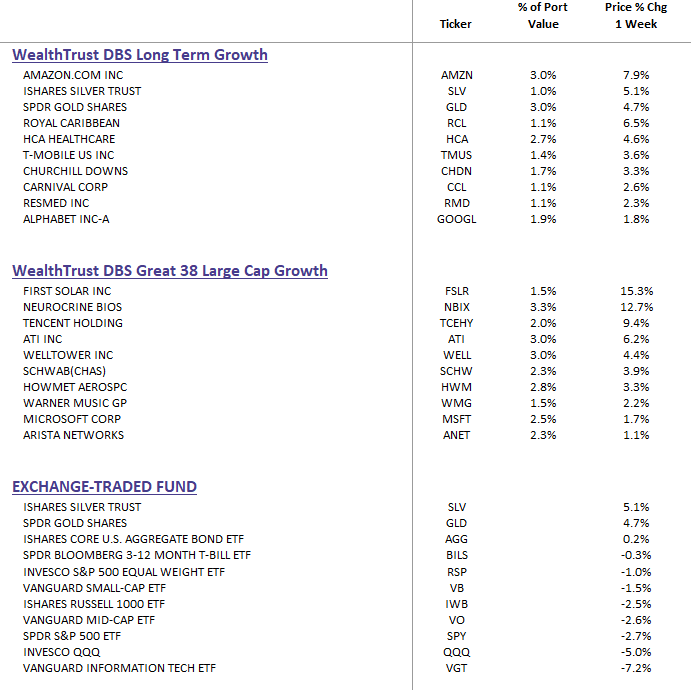
DBS Long-Term Growth & DBS Great 38 Large Cap Growth Top Ten and Benchmark Weekly Performance Summary
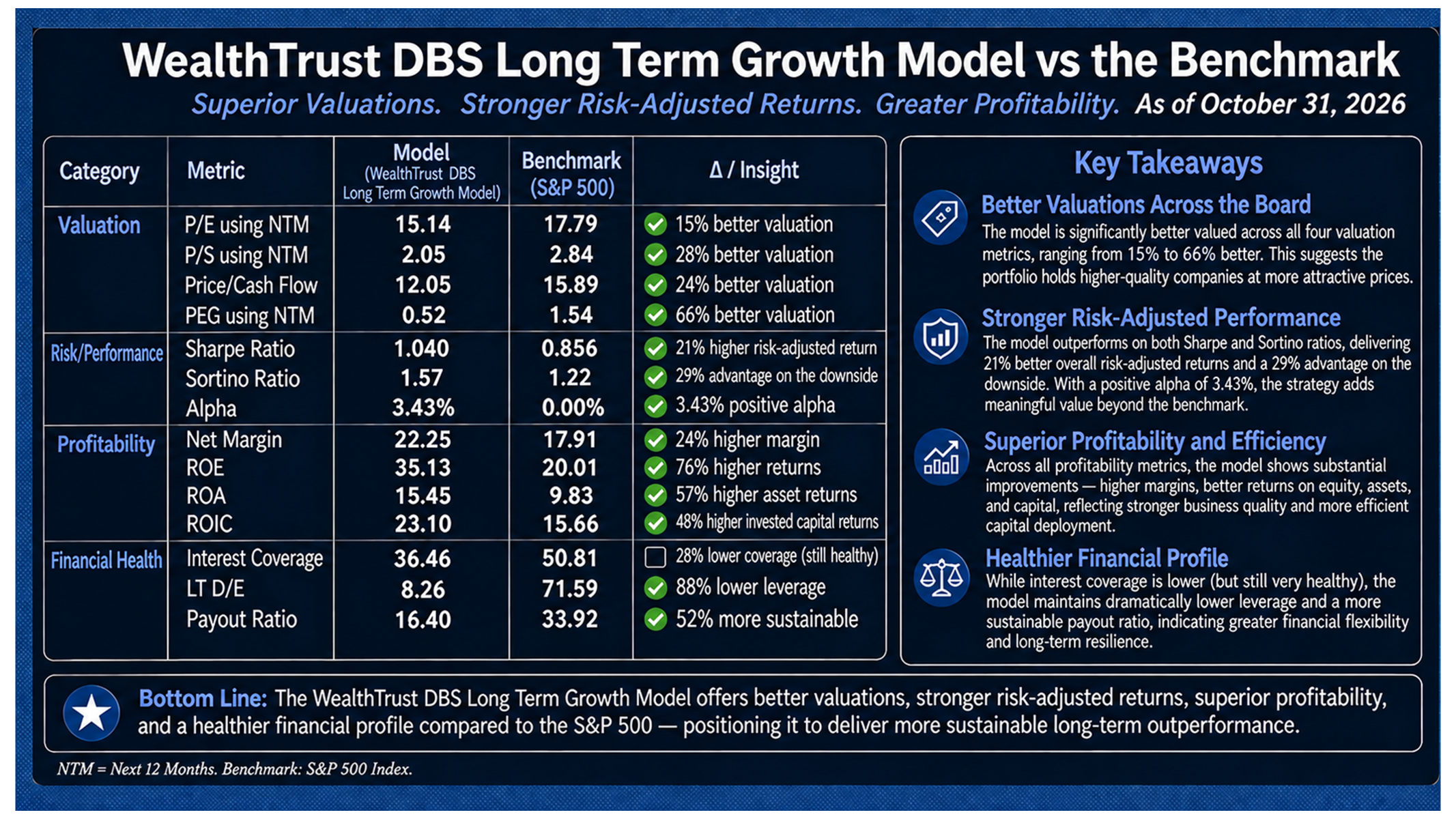
WealthTrust DBS Long Term Growth Model — A Compelling Investment Opportunity in Today's Market
As of October 31, 2026, the WealthTrust DBS Long Term Growth Model demonstrates a compelling combination of attractive valuations, superior profitability, stronger risk-adjusted returns, and financial discipline compared with the S&P 500 Index.
In today's market, where elevated valuations and concentration in a relatively small number of mega-cap companies present potential risks, WealthTrust offers an attractive alternative. Its disciplined investment process seeks to identify financially strong, profitable companies trading at reasonable valuations while maintaining a focus on diversification and risk management.
The investment opportunity: WealthTrust combines growth potential with more attractive valuations and historically stronger risk-adjusted performance, positioning the strategy to potentially capitalize on broader market opportunities while reducing dependence on highly valued market leaders.
With sincere appreciation to each of you who have entrusted your portfolios to our team at WealthTrust.
As many of you know, across multiple market cycles, our disciplined approach has kept us on the right side of the ledger.
We remain available for any questions you may have. Please feel free to schedule a conversation using the calendar link below.
Link to my calendar