

Weekly Market Commentary: September 5, 2026
A Narrow Ledge, not a Panic Tape
Jobs surprise, $91 oil, and a live September FOMC — with leadership still broader than the AI headlines.
The stock market spent the week walking a narrow ledge: oil jumped as the Iran conflict flared, Treasury yields touched their highest levels since late 2023, software and hardware names posted another round of strong earnings, and Friday’s jobs report arrived far hotter than expected. By the close, the tape looked almost unchanged.
That last line still matters. Large-cap growth has not led 2026. The equal-weight S&P 500 is ahead of the cap-weighted index year-to-date (about +14.1% versus +12.8%). Small caps are ahead of both. Energy remains the standout sector. The market is broader than the headlines about a handful of AI platforms imply — and that is exactly the environment in which a numbers first process, with explicit sell rules, earns its keep.
Friday itself was a reminder that “almost unchanged” can hide a lot of motion. After a Thursday rally of more than 1% across the major averages — helped by Fed Governor Christopher Waller’s comment that he could support holding rates if incoming inflation data stay on a cooling path — the August employment report reversed the mood. Stocks gave back some of Thursday’s gains. The S&P 500 finished Friday at 7,718.60, about 1% below its August 13 closing high of 7,798.99. Volatility stayed contained; the VIX hovered in the mid-teens. This is not a panic tape. It is a tape that is pricing two competing facts at once: the economy is still creating jobs, and inflation has not yet returned to the Federal Reserve’s 2% goal.
Jobs First, Then the Fed
August nonfarm payrolls rose 162,000, nearly three times the consensus estimate near 56,000. Revisions to June and July added another 55,000 jobs, including a flip of July from a reported decline into a gain. The unemployment rate held at 4.1%. That is not a labor market that is rolling over. It is a labor market that is still absorbing workers even after a multi-year expansion, a rate-cutting cycle that ended last December, and a geopolitical shock that has kept energy prices elevated.
The policy implication is straightforward. The Federal Open Market Committee meets September 15–16. The federal funds target remains in a 3.50%–3.75% range. Chair Kevin Warsh has framed the mandate in plain language: price stability first, no tolerance for inflation that stays stuck above target. Governor Waller put the next two weeks in equally plain language — if August inflation shows continued progress toward 2%, he can support a hold; if it comes in hot, a hike is on the table. After Friday’s report, rate futures moved the odds of a September increase into a coin-flip-to-better range, roughly the mid-50s to low-60s depending on the snapshot. That is not a forecast. It is the market’s current handicap. The handicap will be rewritten by the August CPI release on September 11.
We do not guess the Committee’s vote. We track the data the Committee said it will use. Headline CPI in July was 3.4% year-over-year; core CPI was 2.5%. The Fed’s preferred gauge, PCE, was 3.7% headline and 3.3% core in July. Energy is the wedge. July CPI energy was up 14.7% from a year earlier, with gasoline up more than 24%. Core goods inflation is muted. Services inflation is slower than it was two years ago but not finished. That mix — cooling core, sticky headline via energy — is why a single jobs print can reprice the front end of the Treasury curve without collapsing the equity market. The 10-year yield spent the week in the mid-to-high 4.70s and tagged about 4.82% midweek, the highest since November 2023, before settling near 4.78%. The two-year finished Friday nearly 4.37%. Higher-for-longer is no longer a slogan. It is the discount rate the market is using until inflation proves otherwise.
Oil Is Not a Sideshow
West Texas Intermediate settled the week near $91 a barrel, up from the mid-$83s at the prior Friday close — a weekly move on the order of 7%. Energy was the best-performing S&P 500 sector on the week, up about 2.3%. Year-to-date, S&P 500 Energy is still the leadership group, with total-return figures in the low-to-mid 40% range depending on the index variant. That is not a trading curiosity. It is the market assigning a price to a six-month conflict that continues to put the Strait of Hormuz and regional supply at risk.
Two points follow for portfolio construction.
First, energy inflation is a tax on the consumer and a cost for every company that moves goods or runs a data center. It is also cash flow for producers. A process that only owns “quality growth” and treats energy as an afterthought is making a sector bet, whether it admits it or not.
Second, oil at $90 is not automatically a recession signal. The labor market just printed 162,000 jobs. Real activity has been resilient. What $90 oil does do is keep the Fed honest. As long as energy is feeding the headline inflation print, the bar for a September hold is higher than it was two weeks ago. That is the cross-current: strong labor plus firm oil equals less room for policy easing, and a live debate about tightening.
Earnings Are Still Doing the Work
Underneath the macro noise, the companies that report numbers — not narratives — continue to separate.
Snowflake reported adjusted earnings of $0.62 versus $0.45 expected, with revenue up 35% and product revenue up 37%, a third consecutive quarter of acceleration, and raised full-year guidance. The stock jumped more than 16% after the print. Dell rose about 15% after beating estimates and lifting guidance. GitLab and other AI-adjacent software names participated. Hewlett Packard Enterprise beat as well. This is the other side of the AI trade: not only the chip designers, but the infrastructure and data platforms that convert capital spending into revenue.
The week was not uniformly kind to the AI complex. Broadcom sold off after a softer revenue outlook — a reminder that the bar for the companies at the center of the buildout is now extremely high. Nvidia announced a $12.9 billion agreement to acquire Hugging Face, a developer-platform move that extends the competitive fight beyond training chips and into the software layer. Lululemon fell more than 17% after missing revenue and cutting its full-year outlook again. Consumer discretionary was the week’s weakest S&P 500 sector, down about 2.1%. That split — enterprise software and select hardware holding up, discretionary retail cracking on guidance — is consistent with a consumer who is employed but price-sensitive, and a corporate sector that is still spending on productivity tools.
Our process starts with earnings revisions, not stories. When revisions are rising and the price has not already discounted every good outcome, we stay engaged. When guidance rolls over and the revision series turns down, we sell. That rule does not matter whether the ticker is fashionable. That rules based process has worked well for us for over the last 24 years.
DBS Great 38 Large Cap Growth & DBS Long Term Growth Top Ten and Benchmark Weekly Performance Summary
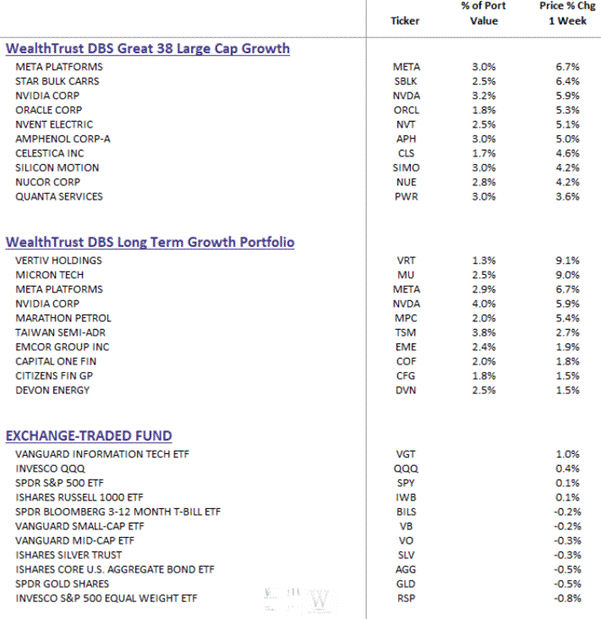
Growth Has Lagged. That Is a Fact, not a Slogan.
We have written this theme for several weeks because the numbers have not changed direction.
The Russell 1000 Growth Index is up only about 4.5% year-to-date, against roughly 12.8% for the S&P 500 and about 14% for the equal-weight S&P 500. Over the last twelve months the gap is similar in spirit: Russell 1000 Growth is up in the order of 10%, while the S&P 500 is up closer to 19%. Small caps, which many investors wrote off as “un-ownable” when rates were rising, are the YTD leaders among the major domestic benchmarks. Energy’s YTD dominance is the other half of the same picture: capital has been paying for cash flow, commodity leverage, and breadth — not just duration and mega cap multiple expansion.
None of that means growth is “dead.” Information technology was still one of the stronger sectors this week (+1.1%), and software earnings were excellent. It means leadership has rotated, concentration risk in the cap-weighted indexes is real (the top ten names still account for the high-30s percent of the S&P 500), and a portfolio that is only a closet Russell 1000 Growth clone has had a harder year than a diversified, revision-driven book. RSP, the equal-weight S&P 500 ETF, crossing $100 billion in assets this month is the industry’s way of admitting the same point. Diversification is not a slogan when the equal-weight index is winning. It is arithmetic.
For WealthTrust strategies, this is the environment the Long Term Growth and Great 38 / Core process is built for: own the names where earnings estimates are being revised higher, keep sector exposure honest when energy and industrials are generating the cash, and do not confuse a five-year AI cycle with a requirement to own every expensive growth name at any price. AI remains a productivity and capex cycle. It is not a substitute for a balance sheet, a margin, or a sell rule.
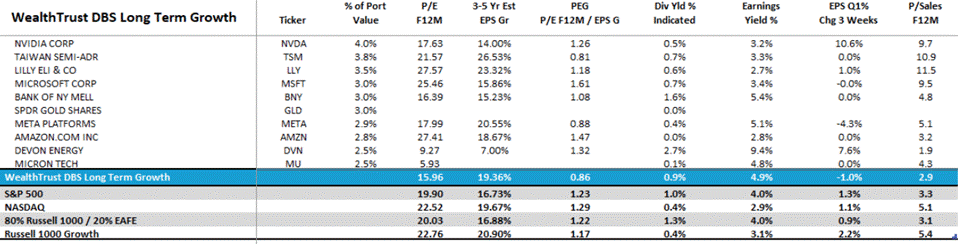
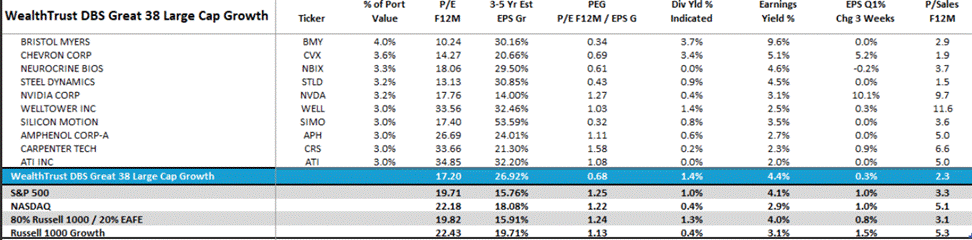
Top 10 Holdings and Metric Comparisons
What We Are Watching Next Week
The calendar is now the policy calendar.
August CPI — Thursday, September 11. This is the print Waller and the rest of the Committee said they need. A cool core number with energy doing less damage would reopen the door to a hold. A hot print, especially if services re-accelerate, would make a 25-basis-point hike the base case into the 15th–16th.
FOMC — September 15–16. The statement, the vote, and Chair Warsh’s press conference will matter more than the dots. Warsh has been explicit about credibility. Markets will parse whether the Committee treats energy as a temporary supply shock or as evidence that policy is not quite restrictive enough.
Earnings revisions in software, semiconductors, energy, and consumer discretionary. One strong Snowflake quarter does not define the group. One Lululemon cut does not define the consumer. The direction of estimate changes over the next two to three weeks will.
Until those data arrive, the working framework is unchanged: the U.S. labor market is not breaking; inflation is not at target; oil is a live input; corporate earnings in the productivity complex remain solid; and leadership YTD has favored breadth and energy over concentrated growth.
How We Are Positioned in This Tape
We do not recast strategy on Friday jobs print. We do use weeks like this to test whether the portfolio still matches the facts.
Earnings revisions first. Names with rising forward estimates and intact guidance stay. Names where the revision series has rolled over leave, regardless of narrative.
Sector honesty. Energy’s YTD leadership is a cash-flow event tied to a real-world supply shock. Ignoring it is a style bet. Over-owning it without a valuation and revision overlay is a different style bet. Both are avoidable.
Growth at a price, not growth at any price. Russell 1000 Growth’s YTD lag is the market telling you that duration-sensitive multiples compress when the 10-year is near 4.8% and the Fed is debating a hike. Quality compounders with accelerating earnings can still work. Multiple-expansion trades on hope have a narrower margin of safety.
Diversification that shows up in the numbers. Equal-weight outperformance and small-cap leadership YTD are evidence that a book concentrated in the same ten names as the cap-weighted index is taking a risk that has not been paid this year.
Liquidity and sell rules before headlines. September plus an FOMC plus $90 oil is a recipe for gap risk. Position sizes should assume that, not hope it away.
The objective has not changed. Clients do not hire an active manager to recite the S&P 500. They hire one to put capital where the estimates are rising, to sell when the estimates stop rising, and to keep enough ballast that a hot jobs number and a spike in crude do not force a conversation nobody wants to have on a Sunday night.
Bottom Line
The week ending September 4 did not resolve the 2026 debate. It sharpened it. Payrolls of 162,000 and $91 oil argue that the Fed’s next decision is live. Software earnings argue that the productivity cycle is intact. Russell 1000 Growth’s mid-single-digit YTD gain against a low-double-digit S&P 500 and a stronger equal-weight index argues that ownership and weighting still matter more than slogans about “the market.”
We will know more after September 11. Until then, the discipline is the same one that built the book: follow the revisions, respect the discount rate, keep sector exposure aligned with the cash flows that are actually arriving, and leave room to act when the data changes.