

Weekly Market Commentary: August 8, 2026
U.S. equities delivered their strongest weekly performance since April, with the major averages advancing broadly and the S&P 500 closing at a fresh record high. The catalyst was a weaker-than-expected July employment report that meaningfully reduced near-term expectations for Federal Reserve tightening, combined with continued strength in corporate earnings—particularly among technology, software, and semiconductor names tied to artificial intelligence investment.
Soft Labor Data Shifts Rate Expectations
The primary market driver arrived Friday with the July nonfarm payrolls report. Employers unexpectedly shed 23,000 jobs, well below consensus expectations for a gain of near 80,000. Prior months were also revised lower. The unemployment rate edged down to 4.1% from 4.2%, though this partly reflected workers leaving the labor force.
Markets interpreted the data as reducing urgency for an immediate rate increase. Odds of a September Fed hike fell sharply—from the mid-to-high 50% range (and higher a week earlier) into the low-to-mid 40% area or below, depending on the measure. The 10-year Treasury yield declined to approximately 4.64–4.65%.
Under new Chair Kevin Warsh, the Federal Reserve has emphasized data dependence and largely abandoned traditional forward guidance. The Committee remains focused on returning inflation to its 2% target and has shown little tolerance for persistent overshoots. The soft payrolls print does not eliminate the possibility of further tightening if inflation data reaccelerate, but it lowers the probability of action at the next meeting and reinforces the market’s preference for patience. Upcoming CPI and PPI reports will be closely watched.
Earnings Momentum Supports the Advance
Corporate results continued to provide a firm fundamental backdrop and were a primary driver of the week’s risk-on tone. With roughly 85% of S&P 500 companies having reported second-quarter results, the earnings season has been one of the strongest in years by several measures.
Approximately 85–86% of reporting companies exceeded EPS estimates—well above the 10-year average of about 76–77% and the highest beat rate since early 2021. Revenue beats have also been solid, running in the mid-to-high 70% range. In aggregate, blended year-over-year earnings growth for the S&P 500 is tracking near 47–50%, the strongest quarterly pace since the second quarter of 2021. Revenue growth is running around 15%, the best reading in several years and well above the long-term average near 7%.
These headline numbers require important context. Large non-operating gains related to equity investments significantly boosted reported results for two major technology companies: Alphabet recorded a substantial unrealized gain primarily tied to its stake in SpaceX, while Amazon recorded a large gain related to its investment in Anthropic. Excluding these items, underlying S&P 500 earnings growth still stands in the high-20% range—robust by any historical standard and consistent with a seventh consecutive quarter of double-digit growth. Full-year 2026 EPS estimates have continued to move higher during the reporting season, with notable upward revisions even after adjusting for one-time items. This positive revision trend is particularly relevant given the importance of earnings momentum in our quantitative framework.
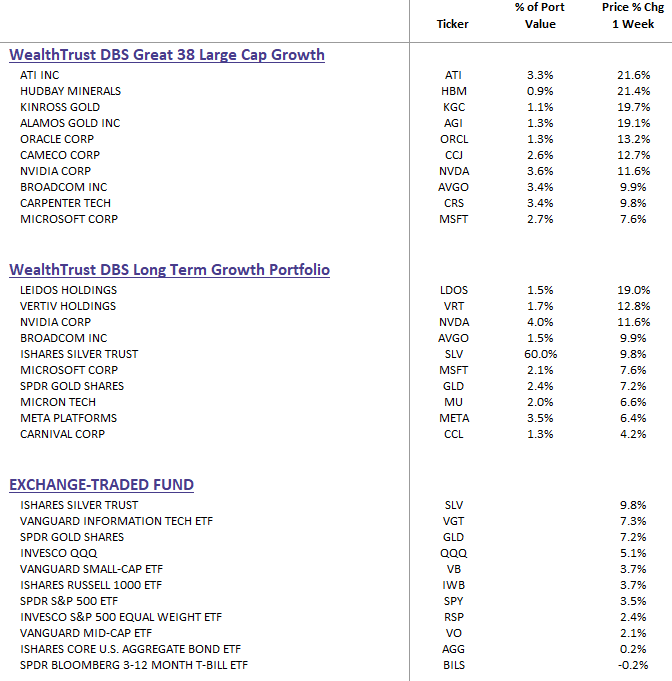
Technology and AI-related names remained central to the growth story. The Information Technology sector is reporting very strong earnings gains, with semiconductors standing out. After a sharp July pullback, the semiconductor complex rebounded forcefully during the week, with the semiconductor ETF advancing more than 7%. Results and commentary from companies tied to AI infrastructure, memory, and related equipment helped ease earlier concerns that elevated capital spending was not yet translating into durable revenue and profit growth. Growth is not confined solely to the largest hyperscalers; software, industrial suppliers benefiting from data-center buildouts, and select other areas have also delivered solid results.
Sector-level performance reflected the earnings picture. Information Technology led with gains exceeding 7% for the week; Materials advanced roughly 5.6%, and Industrials and Consumer Discretionary posted solid advances. Energy lagged on the week despite strong year-over-year earnings growth for the sector (helped by earlier oil-price strength), as near-term price action in crude moderated. Overall participation was constructive, with the majority of sectors finishing higher.
From a process standpoint, the combination of high beat rates, positive estimate revisions, and evidence of broadening (beyond pure one-time gains and mega-cap concentration) is encouraging. We continue to monitor earnings revision trends closely as a key signal within our quantitative and fundamental framework. Elevated AI capital spending remains a structural theme, yet selectivity matters—companies demonstrating clear paths from investment to revenue and earnings growth have been rewarded, while those with less visibility have faced greater scrutiny.
The remaining reports, including key semiconductor results later this month, will provide further data points. For now, the second-quarter earnings season has delivered a meaningful fundamental tailwind that helped propel equities to fresh highs even as the market digested softer labor data and ongoing geopolitical uncertainty.
DBS Long-Term Growth & DBS Great 38 Large Cap Growth Top Ten and Benchmark Weekly Performance Summary
Geopolitics and Energy Remain a Wild Card
Oil prices stayed volatile amid ongoing negotiations related to the Strait of Hormuz and broader Middle East dynamics. Brent crude traded in a wide range during the week, ending in the low-to-mid $80s after earlier spikes tied to supply concerns. Reports of progress toward a framework that could improve shipping lanes through the Strait provided intermittent relief, though a durable resolution remains incomplete.
Energy prices continue to influence inflation expectations and sector performance. The Energy sector underperformed as prices moderated from recent peaks, while lower oil also supported the broader risk-on tone by reducing near-term inflation pressure. Gold prices benefited from the softer rate outlook and geopolitical uncertainty earlier in the period.
Market Internals and Style Trends
Growth outperformed value on the week, consistent with the technology-led rally and the decline in rate-hike probabilities. Large-cap technology and software names drove much of the Nasdaq’s outperformance. Small- and mid-cap indices participated, though leadership remained concentrated in areas tied to AI infrastructure, software, and select cyclical recoveries.
Volatility remained contained. The VIX stayed in the mid-teens, reflecting the combination of strong earnings, a more accommodative near-term rate path, and the absence of acute geopolitical escalation during the week.
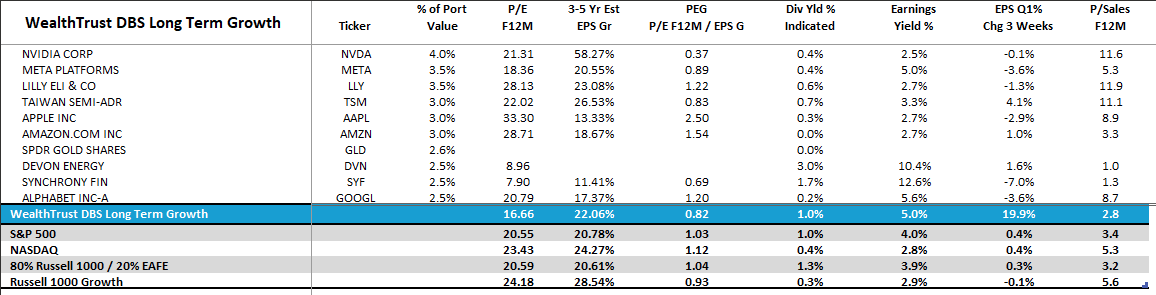
WealthTrust DBS Long Term Growth - Top 10 Equity Review:
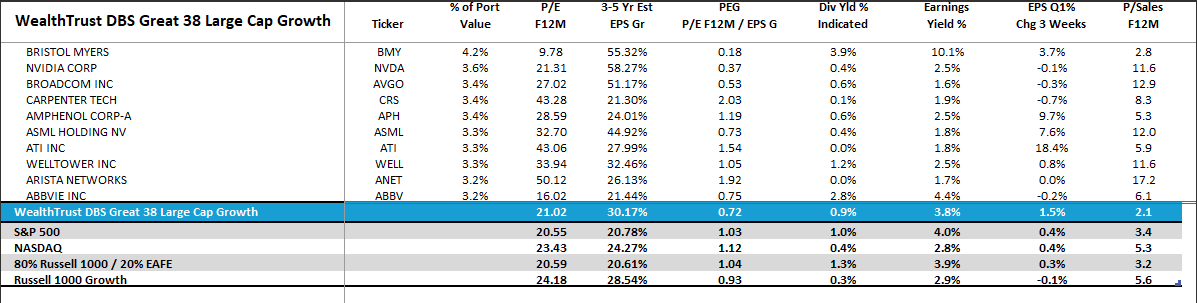
WealthTrust DBS Great 38 Large Cap Growth - Top 10 Equity Review:
Looking Ahead
The coming week brings additional inflation data that will test the market’s current interpretation of the labor report. July CPI is expected to show continued elevation driven in part by earlier energy effects, though core measures will be more important for policy expectations. Producer prices and retail sales will also feature.
Geopolitical developments around the Strait of Hormuz and related negotiations remain a key swing factor for energy prices, inflation expectations, and risk sentiment. Corporate earnings will continue to roll in, providing further evidence on the durability of AI-related spending and broader profit trends.
From a portfolio perspective, the week underscored the importance of earnings momentum and revision trends—core elements of a disciplined, numbers first process. Soft employment data can ease policy pressure in the near term, but the Fed under its current leadership has made clear that price stability remains the priority. Markets are currently pricing a more patient stance; subsequent data will determine whether that view holds.
We continue to emphasize active management with clear sell disciplines, sector and style flexibility, and a focus on companies demonstrating improving fundamentals rather than narrative alone. AI remains a powerful structural theme, yet selectivity and valuation discipline matter. Volatility around data releases and geopolitical headlines is likely to persist, creating both risks and opportunities for investors who maintain a structured process.
Markets have delivered a strong start to August. Sustaining the advance will depend on the interplay of earnings delivery, inflation progress, and the path of monetary policy in an environment still shaped by elevated energy uncertainty and shifting labor dynamics.
At WealthTrust, our goal is to deliver superior risk-adjusted returns over the long term. Thank you to those who have placed their confidence in our firm—it is deeply appreciated.