

Weekly Market Commentary: August 15, 2026
The market continued its measured advance this week, with the S&P 500 posting its third consecutive weekly gain and closing at 7,785.76, up 0.36%. The index briefly touched a new all-time high of 7,798.99 on Thursday before consolidating on Friday. The Nasdaq Composite eked out a modest weekly advance of roughly 0.1%, while the Dow Jones Industrial Average finished lower by about 0.6%. Smaller-capitalization stocks, as measured by the Russell 2000, outperformed with a gain of approximately 1.1%. Year-to-date, the S&P 500 is higher by roughly 13.7%.
This was not a week of broad-based euphoria. It was a week of digestion. Strong corporate earnings and cooler inflation readings provided support, while softer consumer spending data and persistent geopolitical tension in the Middle East introduced caution. The net result was a constructive but selective market environment—one that continues to reward disciplined, numbers-first analysis rather than narrative-driven speculation.
Earnings Remain the Primary Engine
Corporate America continues to deliver. Blended second-quarter S&P 500 earnings growth is tracking nearly 50% year-over-year according to FactSet data, far exceeding the roughly 23% growth expected at the start of reporting season. Even excluding the outsized contributions from certain large technology names, growth remains robust in the low-to-mid 30% range. More than 85% of companies have beaten consensus earnings estimates, well above long-term averages. Revenue growth is running near 15%, the strongest pace since the post-pandemic rebound.
The AI infrastructure cycle remains central to the story. Hyperscaler capital spending continues to translate into tangible demand for semiconductors, networking equipment, memory, and power infrastructure. Memory and storage names, including SanDisk, posted strong moves as investors focused on AI-related bottlenecks. Applied Materials reported solid results and an upbeat outlook, yet the stock declined more than 5% as elevated expectations met a market looking for even stronger forward signals. This pattern—strong absolute results meeting high relative expectations—has become familiar in the later stages of the AI capital expenditure wave. It underscores the importance of monitoring earnings revisions rather than simply celebrating beats.
We continue to view earnings revision momentum as one of the more reliable intermediate-term signals. Companies that are seeing upward revisions to forward estimates, supported by actual order trends and backlog visibility, tend to outperform over subsequent quarters. Those experiencing downward revisions, even after beating the current quarter, often lag. This discipline has guided our quantitative and fundamental process for decades and remains particularly relevant in a market where valuation multiples leave limited room for disappointment.
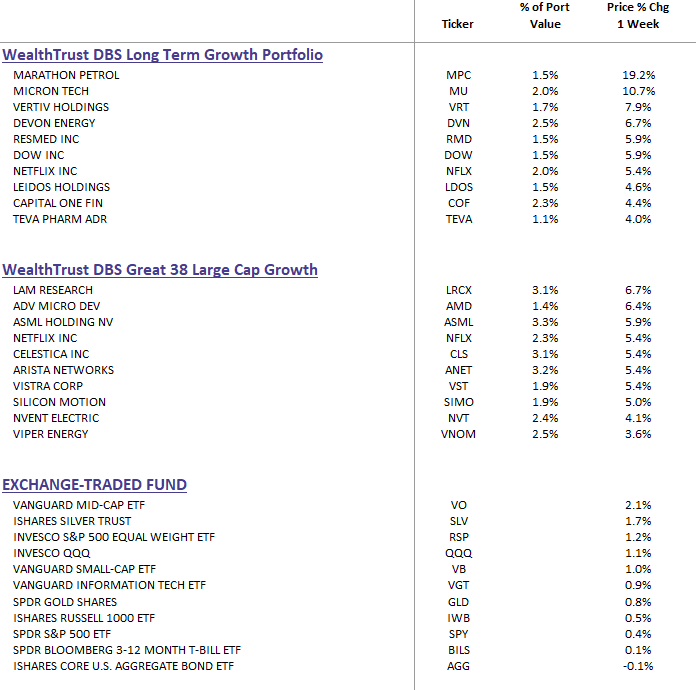
DBS Long-Term Growth & DBS Great 38 Large Cap Growth Top Ten and Benchmark Weekly Performance Summary
Inflation and the Federal Reserve: Room to Pause
July inflation data came in softer than feared. The Consumer Price Index rose 0.1% month-over-month and 3.4% year-over-year. Core CPI increased 0.2% and 2.5% year-over-year. Producer prices were essentially flat on the month, with the year-over-year rate easing to 4.7%. Energy prices declined during the measurement period, providing some relief, though elevated oil prices remain a watch item given ongoing tensions surrounding the Strait of Hormuz.
The softer readings reduced market expectations for a near-term Federal Reserve rate increase. The federal funds target range remains 3.50–3.75%. Under Chair Kevin Warsh, the Fed has offered limited forward guidance, leaving markets more dependent on incoming data. Weak July retail sales (down 0.6% versus expectations of a modest gain) and earlier soft employment data further complicated the picture. Softening demand reduces inflationary pressure but also raises questions about the durability of consumer spending heading into the second half of the year.
The 10-year Treasury yield finished the week in the mid-to-high 4.60% range. Financial conditions remain relatively accommodative for equities, yet they are not loose. Credit spreads remain contained, and equity volatility, while elevated relative to the quietest periods of the year, has not signaled widespread stress.
Geopolitics and Energy: The Persistent Overhang
Oil prices moved higher over the week as diplomatic progress on reopening the Strait of Hormuz remained elusive. West Texas Intermediate settled near $81–82 per barrel and Brent near $88.50 on Friday. Energy equities outperformed as a result. The conflict that began earlier this year continues to inject a risk premium into energy markets and, by extension, into broader inflation expectations.
Markets have so far treated these developments as manageable rather than systemic. Equity indices have advanced even as oil has remained elevated relative to pre-conflict levels. That resilience reflects the offsetting strength of corporate earnings and the view that any eventual resolution would remove a key source of uncertainty. Until clarity improves, however, energy price volatility will remain a factor in both inflation data and corporate cost structures for energy-intensive industries.
Market Breadth and Leadership
Leadership remains concentrated but is showing early signs of modest broadening. Technology and communication services continue to exert outsized influence given their weight in the major indexes. At the same time, energy, certain industrial names, and smaller-capitalization stocks participated more meaningfully this week. Reddit’s announcement that it will join the S&P 500 next week produced a sharp move in that name and highlighted ongoing interest in newer economy companies entering the benchmark.
The market is pricing in continued earnings delivery and a relatively benign policy path. That combination has worked in favor of equities for much of 2026, but it leaves a limited margin for error. We remain attentive to any deterioration in earnings revision trends or unexpected policy shifts.
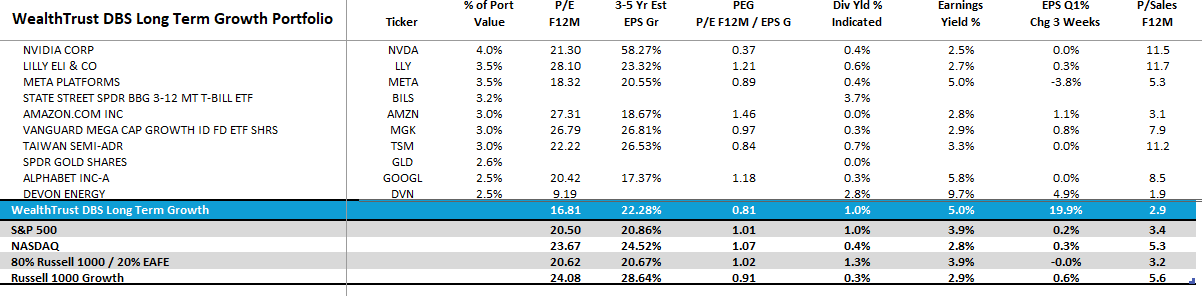
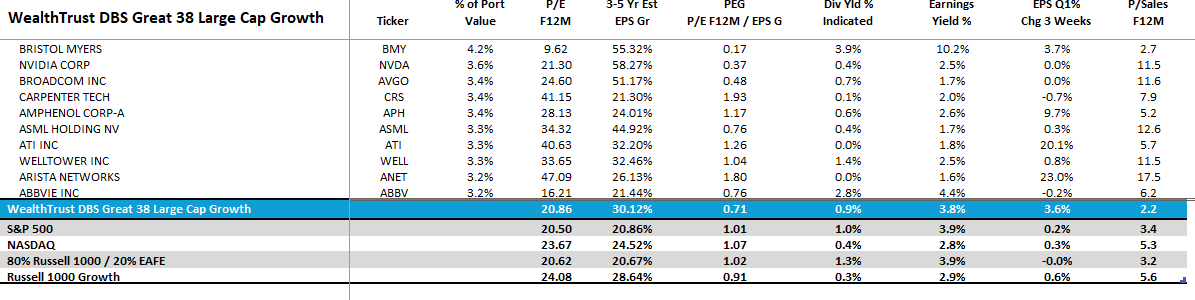
Valuations remain elevated by historical standards, but our WealthTrust DBS Long Term Growth and DBS Great 38 strategies offer significantly lower valuations with higher projected earnings growth rates vs their assigned index(see the analysis below). The Long-Term Growth index is the 80% Russell 1000 / 20%EAFE; the Great 38 index is the Russell 1000 Growth.
Looking Ahead
The coming days will bring additional economic data and the release of Federal Reserve meeting minutes. Retailers begin reporting in greater numbers next week, providing a clearer read on consumer health after the soft July sales figure. Later in the month, attention will turn to key semiconductor results, including Nvidia, which remains a focal point for AI infrastructure demand.
Our process continues to emphasize three core elements: earnings revision analysis, quantitative screening for momentum and quality, and disciplined risk management. Markets can advance for extended periods on the back of strong fundamentals even amid geopolitical noise and mixed data. They can also reverse quickly when those fundamentals begin to disappoint. The current environment favors selectivity over broad exposure and process over prediction.
We will continue monitoring the data closely and adjusting as conditions warrant. As always, the objective remains the same: to position portfolios so that clients can participate in the opportunities the market offers while maintaining the downside awareness.
John G. McHugh President & Chief Investment Officer WealthTrust Asset Management LLC Coming to you from Destin, Florida
Past performance is not indicative of future results. This commentary is for informational purposes only and does not constitute investment advice or a recommendation to buy or sell any security. All investing involves risk, including the possible loss of principal.